
How to Calculate UPPCL Electricity Bill: Urban vs Rural Slabs, Fixed Demand, and 5% Duty (2026)
A practical engineering guide to calculating your Uttar Pradesh electricity bill under official UPERC tariff rules. Understand LMV-1(c) Urban slabs, LMV-1(b) Rural subsidies, fixed demand charges per kW, and 5% UP electricity duty.
Table of Contents
- 1. The regulatory framework: five state DISCOMs under UPERC oversight
- 2. Area classification: urban domestic vs rural domestic
- 3. Official UPPCL domestic tariff slabs table
- 4. Fixed demand charges based on sanctioned connected load
- 5. Uttar Pradesh electricity duty (5% tax assessment)
- 6. BPL lifeline connections and commercial rates
- 7. Step-by-step worked calculation examples
- 8. Visual guide: using the online UPPCL calculator
- 9. Appliance power analysis: summer consumption drivers in Uttar Pradesh
- 10. Four proven techniques to reduce your UPPCL electricity bill
- 11. Frequently asked questions about UPPCL billing
Electricity distribution across Uttar Pradesh serves more than 33 million registered consumers spanning 75 districts. Whether you live in an urban high-rise in Noida or a rural farmhouse near Gorakhpur, your monthly electricity statement is administered under the umbrella of the Uttar Pradesh Power Corporation Limited (UPPCL).
Calculating a power bill in Uttar Pradesh differs substantially from states with flat rates or single slab structures. In Uttar Pradesh, electricity billing is divided by geographic location into two distinct domestic consumer categories: Urban Domestic (LMV-1c) and Rural Domestic (LMV-1b). Each classification carries its own progressive consumption slabs and sanctioned load demand charges, followed by a 5% state electricity duty.
Understanding how these tariff rules operate helps you verify monthly meter readings, avoid reclassification penalties, and manage heavy electrical load efficiently. You can compute your exact figures in seconds using the UPPCL Bill Calculator.
The regulatory framework: five state DISCOMs under UPERC oversight
All electricity retail tariffs across Uttar Pradesh are determined by the Uttar Pradesh Electricity Regulatory Commission (UPERC). Under the latest Aggregate Revenue Requirement (ARR) and Tariff Order, the commission maintained existing domestic rates without tariff hikes, protecting consumers across all five state distribution companies:
- PVVNL (Paschimanchal Vidyut Vitran Nigam Limited): Covers Meerut, Noida, Ghaziabad, and western districts.
- MVVNL (Madhyanchal Vidyut Vitran Nigam Limited): Covers Lucknow, Ayodhya, Bareilly, and central districts.
- DVVNL (Dakshinanchal Vidyut Vitran Nigam Limited): Covers Agra, Mathura, Aligarh, and southern districts.
- PuVVNL (Purvanchal Vidyut Vitran Nigam Limited): Covers Varanasi, Prayagraj, Gorakhpur, and eastern districts.
- KESCO (Kanpur Electricity Supply Company): Operates the urban network of Kanpur city.
Regardless of which regional DISCOM supplies your feeder line, the retail tariff rules established by UPERC apply identically across the state.
Area classification: urban domestic vs rural domestic
The most critical factor in determining your UPPCL electricity bill is whether your connection is classified as Urban or Rural:
- LMV-1(c) Urban Domestic: Applies to consumers residing within municipal corporation boundaries, development authorities, and notified urban areas. Power is supplied through four progressive tiers ranging from ₹5.50 to ₹7.00 per unit, with a monthly sanctioned load demand charge of ₹110.00 per kW.
- LMV-1(b) Rural Domestic: Applies to metered consumers in gram panchayats and rural village feeders. Power is billed across five subsidized tiers starting at ₹3.35 per unit up to ₹6.00 per unit, with a reduced monthly demand charge of ₹90.00 per kW.
Because rural tariffs receive substantial state budget subsidies, consuming identical units on a rural meter produces a noticeably lower bill than on an urban meter.
Official UPPCL domestic tariff slabs table
UPPCL bills residential consumers on a 30-day monthly cycle using progressive telescopic slabs. Here is the active rate card verified under the UPERC tariff schedule:
| Category & Slab Range | Energy Rate (₹/unit) | Fixed Demand Charge | Electricity Duty | Billing Method |
|---|---|---|---|---|
| Urban LMV-1(c): 0 to 150 units | ₹5.50 | ₹110.00 / kW / month | 5% on Energy | Telescopic (Base Tier) |
| Urban LMV-1(c): 151 to 300 units | ₹6.00 | ₹110.00 / kW / month | 5% on Energy | Telescopic (Tier 2) |
| Urban LMV-1(c): 301 to 500 units | ₹6.50 | ₹110.00 / kW / month | 5% on Energy | Telescopic (Tier 3) |
| Urban LMV-1(c): Above 500 units | ₹7.00 | ₹110.00 / kW / month | 5% on Energy | Telescopic (Upper Tier) |
| Rural LMV-1(b): 0 to 100 units | ₹3.35 | ₹90.00 / kW / month | 5% on Energy | Telescopic (Subsidized Base) |
| Rural LMV-1(b): 101 to 150 units | ₹3.85 | ₹90.00 / kW / month | 5% on Energy | Telescopic (Rural Tier 2) |
| Rural LMV-1(b): 151 to 300 units | ₹5.00 | ₹90.00 / kW / month | 5% on Energy | Telescopic (Rural Tier 3) |
| Rural LMV-1(b): 301 to 500 units | ₹5.50 | ₹90.00 / kW / month | 5% on Energy | Telescopic (Rural Tier 4) |
| Rural LMV-1(b): Above 500 units | ₹6.00 | ₹90.00 / kW / month | 5% on Energy | Telescopic (Rural Upper Tier) |
To see how these rates compare with other northern states, you can cross-check using our State Electricity Tariff Comparison Calculator.
Fixed demand charges based on sanctioned connected load
In Uttar Pradesh, fixed charges are calculated directly from your sanctioned connected load in kilowatts (kW) recorded in your consumer connection agreement:
Monthly Fixed Charge = Sanctioned Connected Load (kW) × Tariff Rate
- For Urban Domestic LMV-1(c): ₹110.00 per kW per month
- For Rural Domestic LMV-1(b): ₹90.00 per kW per month
For an urban household with a 2 kW sanctioned load, the fixed demand charge is 2 × ₹110.00 = ₹220.00 per month. If your load is 4 kW, the monthly fixed charge becomes 4 × ₹110.00 = ₹440.00 per month. If your actual peak consumption exceeds your sanctioned load during meter inspection, UPPCL may automatically increase your sanctioned load on your next bill.
Uttar Pradesh electricity duty (5% tax assessment)
Under the Uttar Pradesh Electricity (Duty) Act, a statutory electricity duty of 5.00% is levied on residential electricity bills.
An important consumer detail in Uttar Pradesh is that electricity duty is assessed solely on Base Energy Charges:
Electricity Duty = Total Energy Charges × 5%
Unlike states like Maharashtra that apply duty to fixed and infrastructure fees, Uttar Pradesh excludes fixed demand charges from the tax base. For example, if your base energy charges total ₹1,425.00, your electricity duty is ₹1,425.00 × 0.05 = ₹71.25.
BPL lifeline connections and commercial rates
Beyond standard urban and rural residential categories, UPERC enforces distinct rules for lifeline and commercial users:
LMV-1(a) BPL lifeline connection
- Eligibility: Strictly reserved for below poverty line families with a sanctioned connected load of 1 kW or less and monthly consumption up to 100 units.
- Energy Rate: Subsidized rate of ₹3.00 per unit.
- Fixed Charge: Flat ₹50.00 per month.
- Reclassification Rule: If monthly consumption exceeds 100 units, the consumer is automatically billed under standard LMV-1(c) Urban Domestic rates for that billing cycle.
LMV-2 commercial connections (shops, offices, clinics)
- Connected load up to 4 kW: Fixed demand charge of ₹330.00 per kW per month. First 300 units are billed at ₹7.50 per unit, and units above 300 are billed at ₹8.40 per unit.
- Connected load exceeding 4 kW: Fixed demand charge of ₹450.00 per kW per month, with all consumption billed at a flat rate of ₹8.75 per unit.
Step-by-step worked calculation examples
Here are four real-world billing calculations demonstrating how UPPCL applies these rules across different consumer tiers.
Case 1: Urban domestic, 250 units, 2 kW load
For an urban family in Lucknow or Noida consuming 250 units on a 2 kW connection:
- Slab 1 Energy Charge (first 150 units): 150 × ₹5.50 = ₹825.00
- Slab 2 Energy Charge (remaining 100 units): 100 × ₹6.00 = ₹600.00
- Total Base Energy Charges: ₹825.00 + ₹600.00 = ₹1,425.00
- Fixed Demand Charge: 2 kW × ₹110.00 = ₹220.00
- Electricity Duty (5% of ₹1,425.00): ₹71.25
- Net Payable Bill: ₹1,425.00 + ₹220.00 + ₹71.25 = ₹1,716.25
Case 2: Rural domestic, 250 units, 2 kW load
For a rural household consuming the identical 250 units on a 2 kW rural feeder:
- Slab 1 Energy Charge (first 100 units): 100 × ₹3.35 = ₹335.00
- Slab 2 Energy Charge (next 50 units): 50 × ₹3.85 = ₹192.50
- Slab 3 Energy Charge (remaining 100 units): 100 × ₹5.00 = ₹500.00
- Total Base Energy Charges: ₹335.00 + ₹192.50 + ₹500.00 = ₹1,027.50
- Fixed Demand Charge: 2 kW × ₹90.00 = ₹180.00
- Electricity Duty (5% of ₹1,027.50): ₹51.38
- Net Payable Bill: ₹1,027.50 + ₹180.00 + ₹51.38 = ₹1,258.88
Notice that for the exact same 250 units of power, the rural consumer pays ₹1,258.88 compared to ₹1,716.25 in the city, saving ₹457.37 due to state rural tariff subsidies.
Case 3: BPL lifeline, 80 units, 1 kW load
For an eligible BPL lifeline consumer staying within the 100-unit cap:
- Base Energy Charge: 80 units × ₹3.00 = ₹240.00
- Fixed Demand Charge: Flat ₹50.00
- Electricity Duty (5% of ₹240.00): ₹12.00
- Net Payable Bill: ₹240.00 + ₹50.00 + ₹12.00 = ₹302.00
Case 4: Urban domestic, 600 units, 4 kW load (heavy summer usage)
For a larger urban home running multiple air conditioners during hot months:
- Slab 1 (0 to 150 units @ ₹5.50): 150 × ₹5.50 = ₹825.00
- Slab 2 (151 to 300 units @ ₹6.00): 150 × ₹6.00 = ₹900.00
- Slab 3 (301 to 500 units @ ₹6.50): 200 × ₹6.50 = ₹1,300.00
- Slab 4 (501 to 600 units @ ₹7.00): 100 × ₹7.00 = ₹700.00
- Total Base Energy Charges: ₹825.00 + ₹900.00 + ₹1,300.00 + ₹700.00 = ₹3,725.00
- Fixed Demand Charge: 4 kW × ₹110.00 = ₹440.00
- Electricity Duty (5% of ₹3,725.00): ₹186.25
- Net Payable Bill: ₹3,725.00 + ₹440.00 + ₹186.25 = ₹4,351.25
Visual guide: using the online UPPCL calculator
The interactive calculator at inbillcalculator.com/uppcl-bill-calculator incorporates all UPERC formulas, category toggles, and load parameters:
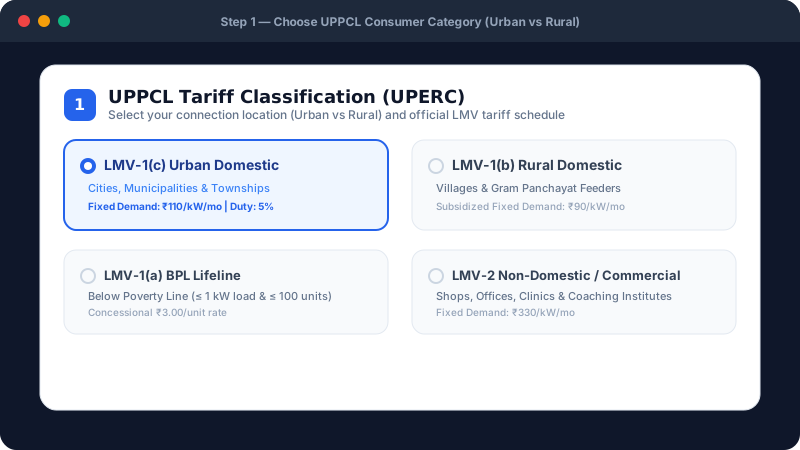
- Step 1: Select Tariff Classification: Choose between LMV-1(c) Urban Domestic, LMV-1(b) Rural Domestic, LMV-1(a) BPL Lifeline, or LMV-2 Commercial.
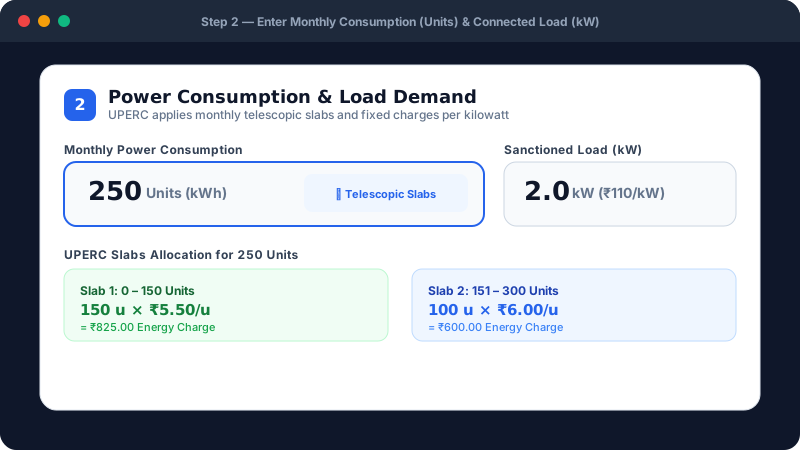
- Step 2: Input Monthly Consumption and Load: Enter your monthly consumption in units (kWh) and your sanctioned connected load in kW.
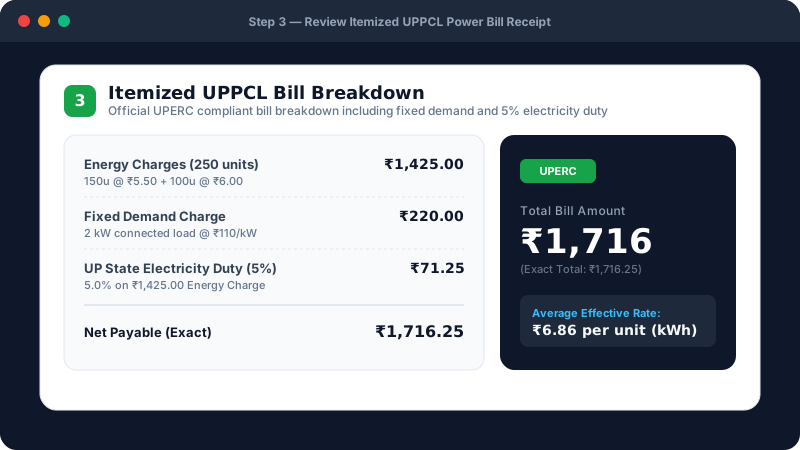
- Step 3: Review Itemized Bill Receipt: Check your progressive slab breakdown, demand charges, 5% electricity duty, and total net payable bill.
Appliance power analysis: summer consumption drivers in Uttar Pradesh
During intense summer heatwaves across the Indo-Gangetic plains, air conditioning represents the largest portion of domestic power bills. You can compute individual device electricity consumption with our Electricity Unit (kWh) Calculator.
| Household appliance | Average wattage | Daily operating hours | Monthly units (kWh) | Monthly bill impact (Urban Tier 2 @ ₹6.00) |
|---|---|---|---|---|
| Inverter AC (1.5 Ton, 5-Star) | 1,000W - 1,200W | 8 hours / night | 120 - 145 units | ₹720.00 - ₹870.00 |
| Desert Air Cooler (200W) | 200W | 10 hours / day | 60 units | ₹360.00 |
| Storage Water Geyser (Winter) | 2,000W | 1.5 hours / day | 90 units | ₹540.00 |
| Refrigerator (260L Frost-Free) | 180W | 24 hours (cyclic) | 42 units | ₹252.00 |
| BLDC Ceiling Fans (3 units) | 28W each (84W total) | 14 hours / day | 35.3 units | ₹211.80 (Saves ₹355/mo) |
| Induction Cooktop (1.8 kW) | 1,800W | 1 hour / day | 54 units | ₹324.00 |
| Water Submersible Pump (1 HP) | 750W | 1.5 hours / day | 33.75 units | ₹202.50 |
For homeowners managing air conditioner running costs, our specialized AC Electricity Cost Calculator lets you calculate precise seasonal bills by tonnage and daily hours.
Four proven techniques to reduce your UPPCL electricity bill
To prevent high summer power bills in Uttar Pradesh, implement these four operational practices:
- Right-size your sanctioned connected load: Review your monthly UPPCL statement to verify that your sanctioned load matches your actual requirement. If your agreement lists 5 kW but your peak usage never exceeds 3 kW, reducing your load by 2 kW saves ₹220.00 each month in urban fixed charges, totaling ₹2,640.00 annually.
- Keep inverter air conditioning at 25°C or 26°C: Dropping thermostat settings to 18°C causes the AC compressor to draw peak electrical load continuously. Setting the thermostat to 25°C provides comfortable cooling while cutting compressor power consumption by 25% to 30%.
- Adopt PM Surya Ghar rooftop solar net metering: Uttar Pradesh offers state and central subsidies for rooftop solar installations through the UPPCL Portal. Installing a 3 kW grid-tied solar system produces approximately 360 units per month, eliminating high-tier slab charges entirely. You can evaluate payback periods with our Solar Rooftop Savings Estimator.
- Monitor digital meter readings regularly: Note your cumulative kilowatt-hour reading midway through the month. If your usage is trending toward upper tiers (such as crossing 300 or 500 units), adjust non-critical appliance usage to finish the cycle in a lower bracket.
Frequently asked questions about UPPCL billing
How can I verify whether my connection is billed under Urban or Rural tariff?
Check the header of your UPPCL electricity bill under the Tariff Code or Supply Type field. If the bill displays LMV-1(c), you are charged under Urban domestic rates. If it displays LMV-1(b), you are billed under subsidized Rural domestic rates.
What happens if an electricity consumer exceeds their sanctioned load?
If your recorded maximum demand indicator (MDI) exceeds your sanctioned load across multiple consecutive billing cycles, UPPCL may issue a notice and automatically enhance your sanctioned load on subsequent bills, resulting in higher monthly fixed demand charges.
Why is electricity duty in Uttar Pradesh lower than in Maharashtra?
Under the Uttar Pradesh Electricity (Duty) Act, electricity duty is set at 5% and is levied exclusively on energy charges. In contrast, states like Maharashtra levy a 16% duty assessed on the composite sum of energy, wheeling, and fixed charges.
Can tenants pay UPPCL bills online using the consumer account number?
Yes. Any consumer or tenant can view and pay bills online via the official UPPCL consumer portal by entering their 10-digit rural account ID or 10-digit urban consumer number.
Where can I compare Uttar Pradesh electricity rates with other states?
You can compare UPPCL slabs with Maharashtra's wheeling charge system using the MSEDCL Bill Calculator, explore Bangalore's single flat rate structure with the BESCOM Bill Calculator, review Tamil Nadu's 60-day cycle with the TNEB Bill Calculator, or check Kerala's telescopic rates with the KSEB Bill Calculator. For all Indian electricity utilities, browse the All India DISCOM Directory.
Found this helpful?
Share this guide with neighbors and family to help them cut electricity waste.
Mehedi
Chief Editor & Lead Systems AdminSenior energy analyst leading the editorial team across all-India state electricity regulatory commission (SERC) tariff orders, subsidy updates, and billing algorithm audits.