
How to Calculate BESCOM Electricity Bill: Bangalore LT-1 Flat Rate, Gruha Jyothi Zero Bill Rules, and Surcharges (2026)
A practical guide to calculating your BESCOM electricity bill in Bangalore. Understand the single uniform rate of ₹5.80 per unit, fixed demand charges, 9% electricity tax, and how Gruha Jyothi provides a zero bill or cliffs at 200 units.
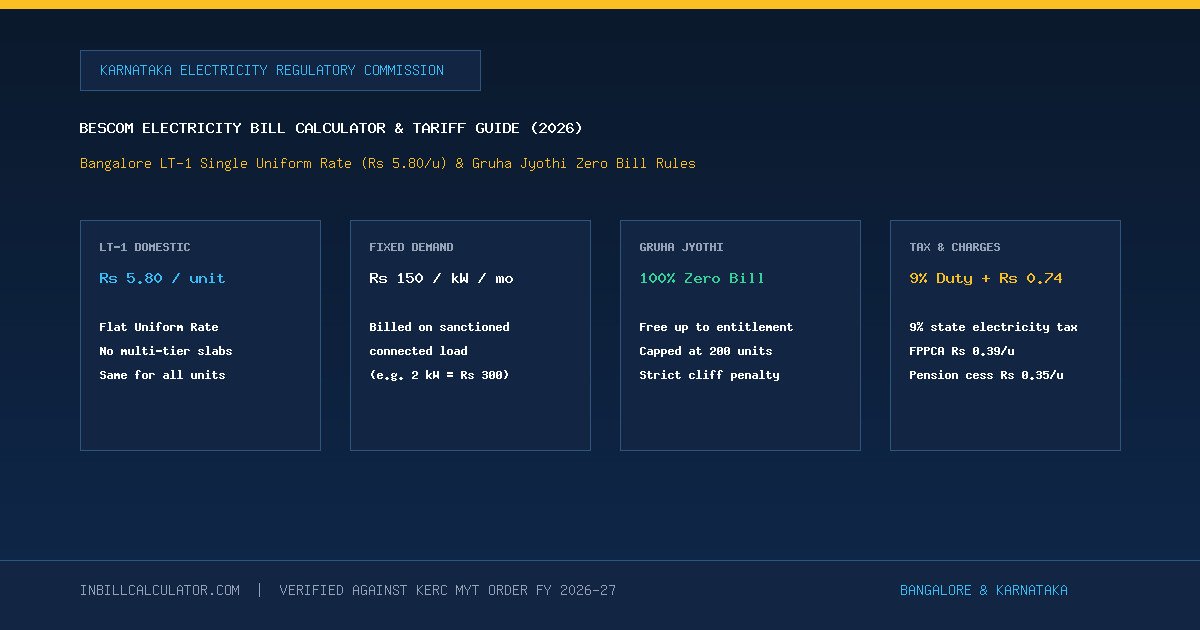
Table of Contents
- 1. The single uniform flat rate system: why Karnataka retired multi-tier slabs
- 2. Fixed demand charges, state electricity tax, and mandatory surcharges
- 3. The Karnataka Gruha Jyothi Scheme: entitlement formula and billing rules
- 4. Step-by-step worked calculation examples
- 5. Visual guide: using the online BESCOM calculator
- 6. Commercial LT-2 tariff overview
- 7. Appliance wattage breakdown: managing household power draw in Bangalore
- 8. Four practical methods to protect your Gruha Jyothi zero bill
- 9. Frequently asked questions about BESCOM billing
A domestic consumer in Bangalore receives their monthly electricity bill and notices a significant difference from how friends or relatives are billed in neighboring states like Tamil Nadu or Kerala. In Karnataka, there are no ascending tariff slabs where the first 50 units cost one price and higher units cost another. Under the regulatory framework established by the Karnataka Electricity Regulatory Commission (KERC), domestic consumers are billed at a single uniform flat rate.
Electricity distribution across Bangalore Urban, Bangalore Rural, and seven adjoining districts is managed by the Bangalore Electricity Supply Company Limited (BESCOM). In addition to base energy charges, your bill includes fixed connected load charges, a 9% state electricity tax, and variable fuel surcharges. Layered over this retail structure is the Karnataka Government flagship Gruha Jyothi Scheme, which provides a zero bill for eligible households consuming within their personalized monthly entitlement up to 200 units.
Understanding how these elements interact helps you audit your monthly bill, manage household appliance consumption, and avoid the steep financial penalty of crossing the 200-unit subsidy threshold.
The single uniform flat rate system: why Karnataka retired multi-tier slabs
Most electricity boards across India use progressive telescopic slabs to penalize high consumption. Karnataka previously used four residential slabs (0 to 50, 51 to 100, 101 to 200, and above 200 units). Under the Multi-Year Tariff order, KERC consolidated the residential consumer class into a single tariff category: LT-1 Domestic.
Under KERC regulations, every unit of active energy recorded by your meter is billed at an identical base price:
- Base Energy Charge: ₹5.80 per unit (kWh)
- Slab Multipliers: None. Whether your home consumes 45 units or 195 units in a monthly billing cycle, every unit is multiplied directly by ₹5.80.
This uniform pricing makes base energy calculations straightforward. If your meter records 130 units, your base energy charge is exactly 130 × ₹5.80 = ₹754.00. You can test your own figures in seconds using the BESCOM Bill Calculator.
Fixed demand charges, state electricity tax, and mandatory surcharges
Your total BESCOM electricity bill contains four statutory billing layers beyond base energy consumption:
| Billing component | Statutory rate | Assessment basis | Impact on monthly bill |
|---|---|---|---|
| Fixed Demand Charge | ₹150.00 / kW / month | Sanctioned connected load | ₹300.00 / month for standard 2 kW domestic load |
| Electricity Tax (Duty) | 9.00% | Base energy charges | Levied under Karnataka Electricity Taxation Act |
| Fuel Cost Adjustment (FPPCA) | ~₹0.39 / unit | Monthly kWh consumption | Adjusted periodically based on power procurement costs |
| Pension & Gratuity Surcharge | ₹0.35 / unit | Monthly kWh consumption | Statutory employee trust fund recovery charge |
1. Sanctioned connected load charge
BESCOM assesses a monthly fixed demand charge of ₹150.00 per kilowatt (kW) based on the sanctioned load recorded in your electricity supply agreement. For a standard residential apartment or independent house with a 2 kW sanctioned load, the fixed demand charge is ₹300.00 per month. For larger homes with a 5 kW connection, the monthly fixed charge is ₹750.00, regardless of whether energy is consumed during that billing cycle.
2. Karnataka electricity tax (9.00%)
The state government levies a statutory duty of 9.00% on base energy charges under the Karnataka Electricity Taxation Act. This tax is assessed strictly on the energy charge, not on the fixed demand charge. For instance, if your base energy charge is ₹580.00, your electricity tax is ₹580.00 × 0.09 = ₹52.20.
3. Fuel surcharges (FPPCA) and pension cess (~₹0.74 per unit)
To recover fluctuating power purchase costs and statutory employee pension commitments, BESCOM adds two per-unit surcharges:
- FPPCA (Fuel and Power Purchase Cost Adjustment): Approximately ₹0.39 per unit, revised periodically by KERC based on generating station fuel expenditure.
- Pension & Gratuity Surcharge: Fixed at ₹0.35 per unit.
- Combined Surcharge Impact: Approximately ₹0.74 per unit consumed.
The Karnataka Gruha Jyothi Scheme: entitlement formula and billing rules
The Government of Karnataka introduced the Gruha Jyothi Scheme to provide financial relief to residential households. The scheme provides free electricity up to 200 units per month, but the qualification is governed by an individualized entitlement formula rather than an automatic blanket grant.
The official entitlement formula
Your personalized monthly quota is calculated using your historical usage pattern:
Entitlement Limit = (Previous 12-Month Average Monthly Consumption) + 10% Buffer
This entitlement is subject to a hard statutory ceiling of 200 units per month. For example, if your average consumption over the preceding 12 months was 110 units, your entitlement limit is 110 + 11 = 121 units. If your historical average was 190 units, adding 10% yields 209 units, but the entitlement is capped at the maximum statutory ceiling of 200 units.
Based on this entitlement limit, your monthly bill is processed through three regulatory scenarios:
Rule 1: Monthly consumption is less than or equal to entitlement (Zero Bill)
If your meter reading shows consumption at or below your calculated entitlement limit, the Karnataka Government subsidizes 100% of the gross bill. The subsidy covers:
- Base energy charges (units × ₹5.80)
- Sanctioned load fixed demand charges (load in kW × ₹150.00)
- The 9.00% state electricity duty
- All applicable FPPCA and pension surcharges
Under Rule 1, your Net Payable Amount is ₹0.00. Your monthly statement arrives stamped as a Zero Bill.
Rule 2: Monthly consumption exceeds entitlement but remains under 200 units (Partial Bill)
If your consumption exceeds your entitlement limit but stays under the 200-unit ceiling, you do not lose the entire subsidy. The entitlement quota and the monthly fixed demand charge remain fully subsidized. You only pay for the incremental extra units above your entitlement limit, along with the 9.00% tax and surcharges applicable to those extra units.
For example, with an entitlement of 120 units and an actual consumption of 140 units, your first 120 units and your ₹300 fixed charge are free. You only pay for the remaining 20 units at ₹5.80, plus 9% duty and ₹0.74/unit surcharges on those 20 extra units.
Rule 3: Monthly consumption exceeds 200 units (The Cliff Rule)
The Gruha Jyothi Scheme enforces a strict threshold. If your monthly consumption crosses 200 units by even a single kilowatt-hour (e.g. 201 units), the subsidy is completely revoked. You receive zero free units, zero fixed charge waiver, and zero tax discount. You must pay the full bill for all units from unit 1 at the regular flat rate of ₹5.80 per unit, plus full fixed charges, full tax, and full surcharges.
Consuming 200 units under Gruha Jyothi results in a Net Bill of ₹0.00. Consuming 201 units results in a Net Bill of approximately ₹1,707.00. That single extra unit costs over ₹1,700 due to complete subsidy forfeiture.
Step-by-step worked calculation examples
Here are four concrete real-world cases for a domestic household with a standard 2 kW sanctioned load.
Case 1: 100 units consumed without Gruha Jyothi (Standard non-subsidized bill)
For consumers who opted out of the scheme or do not hold an active Gruha Jyothi registration:
- Base Energy Charges: 100 units × ₹5.80 = ₹580.00
- Fixed Demand Charges: 2 kW × ₹150.00 = ₹300.00
- Electricity Duty (9%): 9% of ₹580.00 = ₹52.20
- Surcharges (FPPCA & Pension): 100 units × ₹0.74 = ₹74.00
- Gross Total: ₹580.00 + ₹300.00 + ₹52.20 + ₹74.00 = ₹1,006.20
- Government Subsidy: ₹0.00
- Net Amount Payable: ₹1,006.20
Case 2: 100 units consumed with Gruha Jyothi (Entitlement = 110 units)
Because actual consumption (100 units) is within the entitlement limit (110 units), Rule 1 applies:
- Gross Bill Amount: ₹1,006.20
- Energy Subsidy: -₹580.00
- Fixed Demand Waiver: -₹300.00
- Tax and Surcharge Subsidy: -₹126.20
- Total Subsidy Credit: -₹1,006.20
- Net Amount Payable: ₹0.00 (Zero Bill)
Case 3: 160 units consumed with Gruha Jyothi (Entitlement = 140 units)
Here, consumption exceeds entitlement by 20 units, but remains well below the 200-unit ceiling. Rule 2 applies:
- Subsidized Entitlement Units: 140 units (Cost: ₹0.00)
- Subsidized Fixed Demand Charge: 2 kW load (Cost: ₹0.00)
- Payable Incremental Energy: 20 units × ₹5.80 = ₹116.00
- Electricity Duty on Incremental Units: 9% of ₹116.00 = ₹10.44
- Surcharges on Incremental Units: 20 units × ₹0.74 = ₹14.80
- Net Amount Payable: ₹116.00 + ₹10.44 + ₹14.80 = ₹141.24
Case 4: 210 units consumed with Gruha Jyothi (Cliff Revoked)
Because consumption crossed the 200-unit boundary, Rule 3 revokes the subsidy entirely:
- Base Energy Charges: 210 units × ₹5.80 = ₹1,218.00
- Fixed Demand Charges: 2 kW × ₹150.00 = ₹300.00
- Electricity Duty (9%): 9% of ₹1,218.00 = ₹109.62
- Surcharges: 210 units × ₹0.74 = ₹155.40
- Total Subsidy Credit: ₹0.00 (Forfeited)
- Net Amount Payable: ₹1,218.00 + ₹300.00 + ₹109.62 + ₹155.40 = ₹1,783.02
Notice the financial contrast: keeping consumption at 200 units results in ₹0.00 payable, while using 210 units results in ₹1,783.02 payable.
Visual guide: using the online BESCOM calculator
The interactive calculator at inbillcalculator.com/bescom-bill-calculator incorporates all KERC formulas, load scaling, and Gruha Jyothi logic:
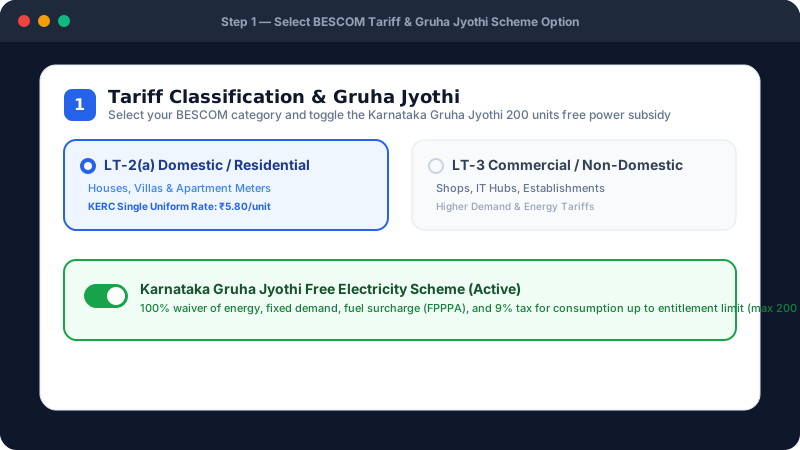
- Step 1: Select Tariff and Subsidy: Choose LT-1 Domestic and toggle Gruha Jyothi scheme status.
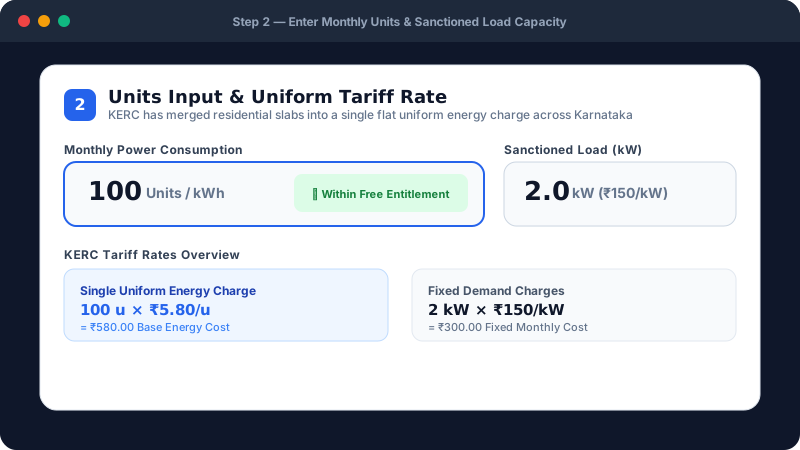
- Step 2: Enter Units and Load: Specify your monthly consumption in kilowatt-hours and sanctioned load in kW.
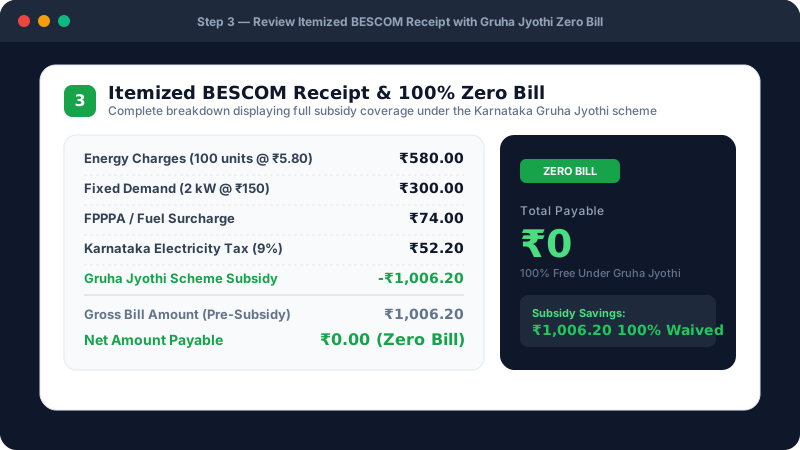
- Step 3: Review Itemized Bill: Examine base energy charges, fixed demand, duty, subsidy credit, and net payable total.
Commercial LT-2 tariff overview
For shops, retail showrooms, clinics, coaching centers, and small office establishments in Bangalore, power is billed under LT-2 Commercial:
- Commercial Energy Charge: ₹8.00 per unit (flat rate)
- Commercial Fixed Demand Charge: ₹210.00 per kW per month
- Electricity Tax: 9.00% on energy charges
- Gruha Jyothi Subsidy: Not applicable (residential domestic only)
For a small retail shop consuming 350 units with a 3 kW commercial load:
- Energy: 350 × ₹8.00 = ₹2,800.00
- Fixed Charge: 3 kW × ₹210.00 = ₹630.00
- Duty (9% of ₹2,800): ₹252.00
- Surcharges (350 × ₹0.74): ₹259.00
- Total Commercial Bill: ₹3,941.00
Appliance wattage breakdown: managing household power draw in Bangalore
Because crossing 200 units revokes your Gruha Jyothi zero bill, understanding the monthly kWh consumption of key domestic appliances is essential. You can calculate individual device draw using the Electricity Unit (kWh) Calculator.
| Household appliance | Average power draw | Typical daily usage | Monthly units (kWh) | Impact on Gruha Jyothi cap |
|---|---|---|---|---|
| Inverter AC (1.5 Ton, 5-Star) | 900W - 1,200W | 6 hours / night | 90 - 130 units | Consumes 45% to 65% of 200-unit cap |
| Storage Water Heater (Geyser) | 2,000W | 1.5 hours / day | 90 units | Consumes 45% of 200-unit cap |
| Frost-Free Refrigerator (260L) | 150W - 220W | Continuous (cyclic) | 35 - 45 units | Consumes 18% to 22% of 200-unit cap |
| BLDC Ceiling Fans (3 units) | 28W each (84W total) | 12 hours / day | 30 units | Saves ~40 units compared to induction fans |
| Induction Cooktop (1.8 kW) | 1,800W | 1 hour / day | 54 units | Consumes 27% of 200-unit cap |
| Water Submersible Pump (1 HP) | 750W | 1 hour / day | 22.5 units | Consumes 11% of 200-unit cap |
For homes running air conditioning during summer months, our dedicated AC Electricity Cost Calculator lets you estimate exact cooling costs by tonnage, star rating, and nightly operating hours.
Four practical methods to protect your Gruha Jyothi zero bill
To avoid crossing the 200-unit threshold and incurring full commercial billing, follow these four operational steps:
- Set your inverter AC thermostat to 25°C or 26°C: Lowering air conditioning temperatures to 18°C forces the compressor to draw continuous peak wattage. In Bangalore's moderate climate, 25°C provides comfortable cooling while cutting AC power draw by 25% to 35%.
- Install a timer on water geysers: Storage water heaters are major contributors to high winter bills in Bangalore. Limiting geyser operation to 20 minutes before morning baths prevents repeated reheat cycles that draw 2,000 watts.
- Take mid-cycle readings from your electronic meter: Note the cumulative kWh reading on the 10th and 20th of each month. If your meter records more than 130 units by day 20, reduce non-essential appliance operation to finish the 30-day cycle below 200 units.
- Investigate rooftop solar net metering: If your monthly demand routinely exceeds 250 units, installing a 2 kW or 3 kW grid-tied rooftop solar system under the PM Surya Ghar scheme can offset your energy consumption. You can evaluate return on investment with our Solar Rooftop Savings Estimator.
Frequently asked questions about BESCOM billing
What happens if my consumption reaches 201 units under Gruha Jyothi?
Under KERC regulations, crossing 200 units forfeits the Gruha Jyothi subsidy entirely. You are billed for all 201 units from unit 1 at the regular flat rate of ₹5.80, plus fixed load demand charges, 9% duty, and surcharges. Your payable bill increases from ₹0.00 to over ₹1,700.
Why does my BESCOM bill have a fixed charge of ₹300 even when consumption is low?
BESCOM assesses fixed demand charges based on sanctioned connected load, set at ₹150.00 per kW per month for LT-1 domestic. If your agreement specifies a 2 kW load, the monthly fixed charge is 2 × ₹150.00 = ₹300.00. If you qualify for Gruha Jyothi and stay within your entitlement, this ₹300 charge is waived by the state government.
How do I calculate the average cost per unit on my BESCOM bill?
Divide your total net payable bill by total units consumed. For non-subsidized domestic bills, the effective rate typically ranges from ₹7.20 to ₹8.50 per unit once fixed charges, 9% duty, and surcharges are factored into base consumption.
Can tenants living in rented apartments claim the Gruha Jyothi subsidy?
Yes. The Gruha Jyothi Scheme is linked to the consumer Account ID (Consumer Number) and the Aadhaar number of the active resident. Tenants residing in Bangalore apartments can register their Aadhaar against the rental meter on the Seva Sindhu portal, provided the Aadhaar is linked to only one active electricity connection across Karnataka.
Where can I compare BESCOM tariffs with other southern states?
You can review detailed state-by-state comparisons with Kerala's slab structure using the KSEB Bill Calculator and Tamil Nadu's bimonthly structure using the TNEB Bill Calculator, or browse all Indian utility rules in the All India DISCOM Directory.
Found this helpful?
Share this guide with neighbors and family to help them cut electricity waste.
Mehedi
Chief Editor & Lead Systems AdminSenior energy analyst leading the editorial team across all-India state electricity regulatory commission (SERC) tariff orders, subsidy updates, and billing algorithm audits.