
How to Calculate TNEB Electricity Bill: TANGEDCO Slabs, 100 Free Units, and Bi-Monthly Rules (2026)
A practical engineering guide to calculating your Tamil Nadu TANGEDCO power bill, explaining 60-day bi-monthly billing, government free unit subsidies, and the financial impact of crossing 500 units.
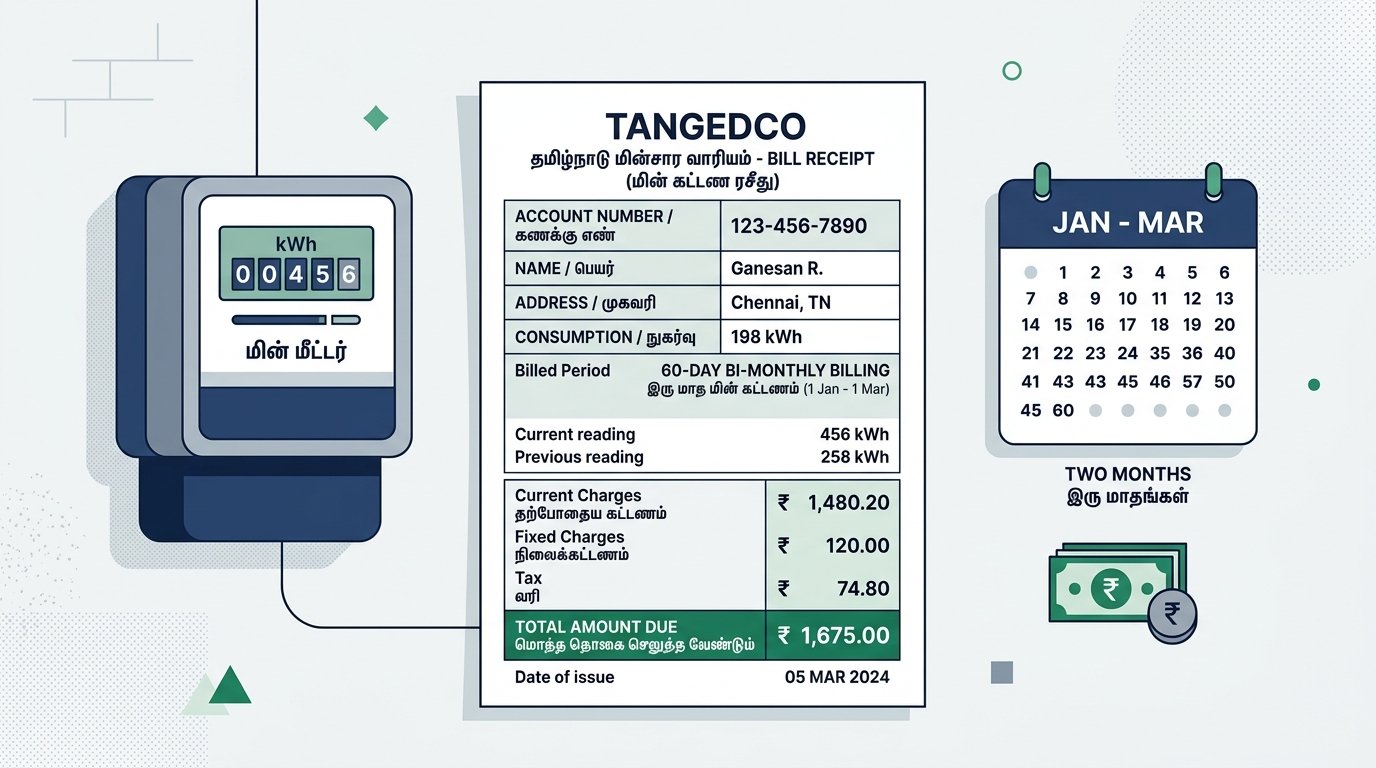
Table of Contents
- 1. Understanding the 60-day bi-monthly billing cycle
- 2. Domestic slab rates and the free units subsidy structure
- 3. TANGEDCO domestic slab rates table
- 4. The 500-unit subsidy threshold: how 50 units increases your bill by ₹935
- 5. Step-by-step example: calculating a 350-unit domestic bill
- 6. Special tariff categories: apartments and commercial connections
- 7. How to read your TANGEDCO static digital meter
- 8. What pushes a Tamil Nadu home past 500 units?
- 9. Practical tips to keep your bi-monthly bill under 500 units
- 10. Frequently asked questions
A residential consumer in Chennai opens their bi-monthly electricity bill expecting a routine amount, only to find the charge has doubled compared to the previous cycle. In many Tamil Nadu households, this jump is not caused by a faulty meter or an undetected wiring leak. It is caused by how the Tamil Nadu Generation and Distribution Corporation (TANGEDCO) structures its 60-day billing cycle and government subsidies.
Tamil Nadu calculates domestic electricity bills once every two months. When your total bi-monthly consumption remains at 500 units or lower, the state government funds a generous subsidy that covers 200 free units. The moment your meter reading reaches 501 units, that subsidy is cut in half to 100 units, while your upper consumption is pushed into higher tariff slabs.
Understanding this bi-monthly tariff structure helps domestic consumers audit their electricity receipts, plan heavy appliance usage, and avoid sudden billing surprises.
Understanding the 60-day bi-monthly billing cycle
Most electricity distribution companies across India issue monthly power bills. Tamil Nadu operates on a bi-monthly cycle for low tension domestic consumers under tariff category LT-1A.
Under regulations set by the Tamil Nadu Electricity Regulatory Commission (TNERC), your meter is read once every 60 days. This means all consumption limits, slab boundaries, and government subsidies apply to your combined usage over two full months:
- A monthly consumption of 200 units translates into a bi-monthly bill of 400 units.
- A monthly consumption of 260 units translates into a bi-monthly bill of 520 units.
- The official 500-unit subsidy limit represents an average daily consumption of approximately 8.3 units across the two-month cycle.
TNERC Order No. 6 sets the base retail tariff, with the state government maintaining a tariff freeze that holds existing domestic slab rates steady through 2026.
Domestic slab rates and the free units subsidy structure
TANGEDCO divides domestic billing into two distinct categories depending on whether total bi-monthly consumption exceeds 500 units.
Tier 1: Bi-monthly consumption of 500 units or fewer
If your total 60-day usage is 500 units or below, you receive the full domestic benefit:
- First 200 units: 100% free of cost, subsidized entirely by the Government of Tamil Nadu (worth up to ₹990.00).
- Units 201 to 400: ₹4.95 per unit.
- Units 401 to 500: ₹6.65 per unit.
- Fixed demand charges: Waived by the government for all domestic LT-1A connections.
- Electricity duty: 0% tax on residential consumption.
If a household uses 200 units or fewer over 60 days, their net electricity bill is exactly ₹0.00.
Tier 2: Bi-monthly consumption exceeding 500 units
When 60-day consumption reaches 501 units, the billing rules change significantly:
- First 100 units: Free of cost (subsidy value drops from ₹990.00 to ₹495.00).
- Units 101 to 400: ₹4.95 per unit.
- Units 401 to 500: ₹6.65 per unit.
- Units 501 to 600: ₹8.80 per unit.
- Units 601 to 800: ₹9.95 per unit.
- Units 801 to 1,000: ₹11.05 per unit.
- Above 1,000 units: ₹12.15 per unit.
You can verify your specific bi-monthly figures using our TNEB Bill Calculator.
TANGEDCO domestic slab rates table
Here is the complete schedule of bi-monthly domestic slabs currently applied across Tamil Nadu:
| Bi-monthly consumption slab | Energy rate per unit | Subsidy status for usage ≤ 500 units | Subsidy status for usage > 500 units |
|---|---|---|---|
| First 100 units (0 to 100) | ₹4.95 | 100% Free (Government subsidy) | 100% Free (Government subsidy) |
| Next 100 units (101 to 200) | ₹4.95 | 100% Free (Government subsidy) | Charged at ₹4.95 per unit |
| Next 200 units (201 to 400) | ₹4.95 | Charged at ₹4.95 per unit | Charged at ₹4.95 per unit |
| Next 100 units (401 to 500) | ₹6.65 | Charged at ₹6.65 per unit | Charged at ₹6.65 per unit |
| Next 100 units (501 to 600) | ₹8.80 | Not applicable | Charged at ₹8.80 per unit |
| Next 200 units (601 to 800) | ₹9.95 | Not applicable | Charged at ₹9.95 per unit |
| Next 200 units (801 to 1,000) | ₹11.05 | Not applicable | Charged at ₹11.05 per unit |
| Beyond 1,000 units | ₹12.15 | Not applicable | Charged at ₹12.15 per unit |
The 500-unit subsidy threshold: how 50 units increases your bill by ₹935
The most common cause of high power bills in Tamil Nadu is crossing the 500-unit threshold. Consider two households with similar lifestyle patterns:
Case A: Household consuming exactly 500 units
Because total usage does not exceed 500 units, the household qualifies for 200 free units:
- Units 0 to 400: 400 units at ₹4.95 = ₹1,980.00
- Units 401 to 500: 100 units at ₹6.65 = ₹665.00
- Gross energy charges: ₹2,645.00
- Less 200 free units subsidy (200 × ₹4.95): -₹990.00
- Net payable bill: ₹1,655.00
Case B: Household consuming 550 units
Because total usage exceeds 500 units, the free units subsidy is halved to 100 units, and the extra 50 units fall into the ₹8.80 slab:
- Units 0 to 400: 400 units at ₹4.95 = ₹1,980.00
- Units 401 to 500: 100 units at ₹6.65 = ₹665.00
- Units 501 to 550: 50 units at ₹8.80 = ₹440.00
- Gross energy charges: ₹3,085.00
- Less 100 free units subsidy (100 × ₹4.95): -₹495.00
- Net payable bill: ₹2,590.00
Comparing Case A and Case B shows that consuming 50 extra units over two months increases the bill from ₹1,655.00 to ₹2,590.00. That is an increase of ₹935.00 for 50 units, working out to an effective marginal cost of ₹18.70 per unit for those additional units.
Half of that increase comes from losing 100 units of free electricity subsidy, while the other half comes from the steep ₹8.80 upper tier rate.
Step-by-step example: calculating a 350-unit domestic bill
Here is how TANGEDCO computes a bill for 350 units over a 60-day cycle:
- Determine total consumption: 350 units falls in the 500 units or lower tier.
- Check subsidy entitlement: 200 units are provided free of cost.
- Calculate billable units: 350 total units minus 200 free units leaves 150 billable units.
- Apply base slab rate: All 150 units sit within the 0 to 400 slab, priced at ₹4.95 per unit.
- Multiply billable units by rate: 150 × ₹4.95 = ₹742.50.
- Check fixed charges: Fixed demand fees are zero for domestic connections.
- Total net payable amount: ₹742.50.
To compare how this bill looks against Kerala or Karnataka, test 350 units on our State Electricity Tariff Comparison Calculator.
Special tariff categories: apartments and commercial connections
TANGEDCO maintains separate classifications for multi-family apartment facilities and small business spaces:
LT-1D: Apartment common services
In residential apartment complexes, meters dedicated to corridor lights, water supply pumps, passenger lifts, and security gates are billed under category LT-1D:
- Energy charge: Flat rate of ₹8.55 per unit on all consumption.
- Fixed demand charge: ₹55 per kW per month (amounting to ₹110 per kW for each bi-monthly bill).
- Electricity duty: 5% tax on total energy charges.
- Individual apartment flats continue to receive domestic LT-1A rates and free unit subsidies on their private meters.
LT-V: Commercial shops and offices
Small retail shops, consultancies, and commercial offices fall under category LT-V:
- For consumption up to 100 units: ₹6.65 per unit.
- For consumption exceeding 100 units: Flat rate of ₹10.45 per unit applied to all units from unit one.
- Fixed demand charge: ₹110 per kW per month (₹220 per kW per bi-monthly bill).
- Electricity duty: 5% tax on energy charges.
How to read your TANGEDCO static digital meter
Electronic digital meters installed across Tamil Nadu cycle through automated display screens every few seconds. To read your consumption accurately:
- Stand in front of the meter and watch the LCD display cycle through date, time, and voltage screens.
- Wait until the screen displays numeric digits alongside the unit marker kWh (Kilowatt Hours).
- Record the whole numbers before the decimal point. This represents your cumulative active energy consumption.
- Check your previous TANGEDCO bill receipt or mobile SMS to find your previous reading.
- Subtract the previous reading from your current reading. The difference is your bi-monthly consumption.
What pushes a Tamil Nadu home past 500 units?
Because the billing period spans 60 days, running seasonal appliances for just a few extra weeks easily doubles your total count:
Split air conditioners
A 1.5-ton 3-star inverter split AC running 7 hours every night consumes roughly 8 units per day. Over a 60-day billing cycle, that single air conditioner accounts for 480 units of electricity. Paired with basic home lighting and a refrigerator, one AC guarantees that your household will cross the 500-unit threshold. You can estimate cooling bills using our AC Electricity Cost Calculator.
Water heaters
A 2,000-watt immersion rod or storage geyser used for one hour daily consumes 2 units per day, or 120 units over 60 days.
Ceiling fans
Four conventional induction ceiling fans (75 watts each) operating 14 hours daily consume approximately 250 units over two months. Replacing them with 28-watt brushless DC (BLDC) fans drops that consumption to under 95 units, saving more than 150 units each billing cycle. You can calculate specific appliance wattages with our Electricity Unit (kWh) Calculator.
Practical tips to keep your bi-monthly bill under 500 units
- Check your meter on day 30 of the billing period. If your consumption is already past 230 units, reduce air conditioner usage or raise setpoint temperatures to keep total usage below 500 units by day 60.
- Set air conditioner thermostats to 24°C or 25°C instead of 18°C or 20°C. This reduces compressor duty cycle without compromising room comfort.
- Clean air conditioner indoor filters every fortnight. Dusty filters restrict airflow, forcing compressors to run longer to reach target temperatures.
- For households consistently using 600 to 900 units bi-monthly, rooftop solar offers significant returns. A 3 kW rooftop solar system generates 700 to 800 units over two months, eliminating all high-tier slabs and bringing net grid consumption close to zero. You can review government subsidy savings on our Solar Rooftop Savings Estimator.
Frequently asked questions
How many free units does TNEB provide to domestic consumers?
TANGEDCO provides 200 free units per bi-monthly bill for households consuming 500 units or fewer. If bi-monthly consumption exceeds 500 units, the free allowance drops to 100 units.
Why is my TNEB electricity bill calculated once every two months?
TANGEDCO operates on a statutory 60-day bi-monthly meter reading schedule for all low tension domestic connections to optimize meter inspection logistics across Tamil Nadu.
What happens if my bi-monthly usage reaches 505 units?
Consuming 505 units reduces your free power subsidy from 200 units to 100 units, and charges the 5 extra units at the ₹8.80 slab rate. This small overage increases your bill by more than ₹500 compared to a 500-unit reading.
Do domestic consumers in Tamil Nadu pay fixed demand charges?
No. Fixed demand charges for LT-1A domestic connections are fully subsidized by the Government of Tamil Nadu, appearing as ₹0.00 on residential bills.
How does TNEB compare with Kerala KSEB electricity tariffs?
Kerala bills monthly with a strict 250-unit non-telescopic cliff, while Tamil Nadu bills bi-monthly with 100 to 200 free units subsidized by the state government. You can inspect all state rate structures on our All State Electricity Boards Directory.
Found this helpful?
Share this guide with neighbors and family to help them cut electricity waste.
Mehedi
Chief Editor & Lead Systems AdminSenior energy analyst leading the editorial team across all-India state electricity regulatory commission (SERC) tariff orders, subsidy updates, and billing algorithm audits.