
How to Calculate MSEDCL Electricity Bill: Mahavitaran Slabs, Wheeling Charges, and 16% Duty (2026)
A complete engineering guide to calculating your MSEDCL Mahavitaran power bill in Maharashtra. Understand LT-1(B) progressive slabs, the flat ₹1.60 wheeling charge, connection phase fees, and the 16% composite electricity duty.
Table of Contents
- 1. Maharashtra electricity regulatory framework: the MERC tariff order
- 2. Understanding the two-part variable charge: energy charges vs wheeling charges
- 3. Official MSEDCL LT-I(B) residential tariff slabs table
- 4. Fixed monthly charges based on electric supply phase
- 5. Maharashtra electricity duty: the 16% composite tax mechanism
- 6. Fuel Adjustment Charge (FAC) and seasonal variations
- 7. Step-by-step worked calculation examples
- 8. Visual guide: using the online MSEDCL calculator
- 9. Commercial LT-II(A) tariff overview
- 10. Appliance wattage breakdown: managing household power draw in Maharashtra
- 11. Four practical strategies to lower your MSEDCL electricity bill
- 12. Frequently asked questions about MSEDCL billing
A domestic consumer in Pune, Nagpur, or Thane opens their monthly electricity bill from the Maharashtra State Electricity Distribution Company Limited (MSEDCL / Mahavitaran) and notices that calculating the total payable amount involves far more than simply multiplying total units by a single rate. Maharashtra operates one of the most structured and multi-layered retail electricity tariff models in India.
Every residential bill in Maharashtra splits your variable cost into two distinct line items: a progressive Base Energy Charge that rises across four consumption brackets, and a mandatory Wheeling Charge of ₹1.60 per unit applied uniformly across all units. On top of that, consumers pay fixed monthly connection charges determined by electric supply phase, followed by a 16% state electricity duty assessed on the combined subtotal.
Understanding how these tariff layers work helps you audit your Mahavitaran monthly statement, verify meter calculations, and avoid crossing into expensive upper slabs. You can test your exact monthly consumption numbers using the online MSEDCL Bill Calculator.
Maharashtra electricity regulatory framework: the MERC tariff order
Electricity distribution across most of Maharashtra, excluding private license areas in Mumbai, is operated by MSEDCL under the statutory oversight of the Maharashtra Electricity Regulatory Commission (MERC). MERC determines retail tariffs through Multi-Year Tariff (MYT) orders, establishing revenue requirements, wheeling charges, and consumer slab rates.
Under the active MERC tariff schedule, low tension residential households fall under tariff category LT-I(B) Residential. Unlike states like Karnataka that eliminated progressive slabs in favor of a flat rate, Maharashtra maintains a telescopic slab model to cross-subsidize low-income and agricultural consumers while encouraging energy conservation among heavy power users.
Understanding the two-part variable charge: energy charges vs wheeling charges
A defining characteristic of an MSEDCL electricity statement is that variable power consumption is never billed as a single number. Instead, your meter units are billed across two separate components:
- Base Energy Charge (EC): The cost of generating and purchasing bulk electricity from thermal, hydro, and renewable stations. This charge is progressive and increases steeply as your consumption climbs into higher brackets.
- Wheeling Charge (WC): The cost of maintaining high-voltage transmission lines, sub-stations, transformers, and local distribution wires. Under MERC regulations, the wheeling charge is fixed at ₹1.60 per unit (kWh) across every unit consumed, regardless of slab tier.
On your bill, both figures are combined to determine your true variable rate per unit. For example, in the initial 100-unit bracket, your base energy charge is ₹3.96 per unit while the wheeling charge is ₹1.60 per unit, creating an effective variable cost of ₹5.56 per unit.
Official MSEDCL LT-I(B) residential tariff slabs table
MSEDCL calculates residential bills on a monthly cycle. Under the active tariff schedule, four telescopic consumption tiers apply to all standard low tension domestic households:
| Monthly consumption slab | Base Energy Charge (₹/unit) | Wheeling Charge (₹/unit) | Combined Variable Rate (₹/unit) | Billing method |
|---|---|---|---|---|
| 1 to 100 units | ₹3.96 | ₹1.60 | ₹5.56 | Telescopic (Subsidized lifeline tier) |
| 101 to 300 units | ₹10.80 | ₹1.60 | ₹12.40 | Telescopic (Standard domestic tier) |
| 301 to 500 units | ₹15.03 | ₹1.60 | ₹16.64 | Telescopic (Heavy consumption tier) |
| Above 500 units | ₹17.53 | ₹1.60 | ₹19.13 | Telescopic (Peak residential tier) |
Because the slabs are telescopic, consuming 250 units does not mean all 250 units are charged at ₹12.40. Your first 100 units are always protected at the ₹5.56 combined rate, and only the remaining 150 units are billed at the higher ₹12.40 rate. To compare these rates with neighboring states, you can inspect our State Electricity Tariff Comparison Calculator.
Fixed monthly charges based on electric supply phase
Unlike utilities in Delhi or Karnataka that multiply fixed charges by your sanctioned load in kilowatts, MSEDCL assesses residential fixed charges as a flat monthly fee based primarily on your electric supply phase:
- LT-I(B) Single Phase: ₹130.00 per month
- LT-I(B) Three Phase: ₹435.00 per month
- LT-I(A) BPL Lifeline (usage up to 30 units and load up to 0.25 kW): ₹35.00 per month
For residential consumers with a standard Single Phase connection, your fixed charge remains ₹130.00 whether your sanctioned load is 1 kW, 2 kW, or 4 kW. However, if your home operates on a Three Phase meter, your fixed charge increases to ₹435.00 per month. If your peak power usage does not require Three Phase supply, converting to Single Phase can save ₹3,660.00 each year in fixed charges alone.
Maharashtra electricity duty: the 16% composite tax mechanism
Maharashtra levies one of the highest electricity duties in the country under the Maharashtra Electricity Duty Act, 2016. In municipal corporation and urban areas, residential and commercial consumers pay a statutory electricity duty of 16.00%.
What makes this tax significant is its calculation base. The state government assesses electricity duty on the composite subtotal of your bill, not just base energy charges:
Electricity Duty = (Base Energy Charges + Wheeling Charges + Fixed Charges + FAC) × 16%
Because the 16% duty is calculated after adding wheeling charges and fixed charges, every unit of electricity you save reduces both your direct energy bill and your government tax liability.
Fuel Adjustment Charge (FAC) and seasonal variations
The Fuel Adjustment Charge (FAC) is a variable surcharge approved by MERC on a quarterly basis. It allows distribution companies to recover or refund differences between estimated and actual fuel procurement costs, particularly coal prices and power exchange purchases.
When generation costs decline or cheaper renewable power is integrated, FAC can drop to zero or reflect a small credit. In periods of high power demand or elevated coal prices, a nominal surcharge of ₹0.15 to ₹0.45 per unit may appear on monthly bills.
Step-by-step worked calculation examples
To understand how MSEDCL combines slabs, wheeling fees, fixed charges, and the 16% duty, consider three real-world domestic scenarios.
Case 1: 100 units consumed on a Single Phase connection
For a compact apartment or energy-conscious household consuming exactly 100 units in a 30-day billing cycle:
- Base Energy Charge: 100 units × ₹3.96 = ₹396.00
- Wheeling Charge: 100 units × ₹1.60 = ₹160.00
- Fixed Charge (Single Phase): ₹130.00
- Fuel Adjustment Charge (FAC): ₹0.00
- Composite Subtotal: ₹396.00 + ₹160.00 + ₹130.00 = ₹686.00
- Electricity Duty (16% of ₹686.00): ₹109.76
- Net Payable Bill: ₹686.00 + ₹109.76 = ₹795.76
The effective cost per unit for this consumption level is approximately ₹7.96 per unit once fixed charges and tax are factored in.
Case 2: 250 units consumed on a Single Phase connection
For a typical family home operating a refrigerator, washing machine, ceiling fans, and moderate air conditioning:
- Slab 1 Energy Charge (first 100 units): 100 × ₹3.96 = ₹396.00
- Slab 2 Energy Charge (remaining 150 units): 150 × ₹10.80 = ₹1,620.00
- Total Base Energy Charges: ₹396.00 + ₹1,620.00 = ₹2,016.00
- Wheeling Charge: 250 units × ₹1.60 = ₹400.00
- Fixed Charge (Single Phase): ₹130.00
- Composite Subtotal: ₹2,016.00 + ₹400.00 + ₹130.00 = ₹2,546.00
- Electricity Duty (16% of ₹2,546.00): ₹407.36
- Net Payable Bill: ₹2,546.00 + ₹407.36 = ₹2,953.36
Notice the transition between Slab 1 and Slab 2. While the first 100 units cost only ₹5.56 per unit in variable charges, the next 150 units cost ₹12.40 per unit, causing the total bill to more than triple from Case 1.
Case 3: 450 units consumed on a Three Phase connection
For a larger household running multiple air conditioners and home appliances on a Three Phase connection:
- Slab 1 Energy Charge (0 to 100 units): 100 × ₹3.96 = ₹396.00
- Slab 2 Energy Charge (101 to 300 units): 200 × ₹10.80 = ₹2,160.00
- Slab 3 Energy Charge (301 to 450 units): 150 × ₹15.03 = ₹2,254.50
- Total Base Energy Charges: ₹396.00 + ₹2,160.00 + ₹2,254.50 = ₹4,810.50
- Wheeling Charge: 450 units × ₹1.60 = ₹720.00
- Fixed Charge (Three Phase): ₹435.00
- Composite Subtotal: ₹4,810.50 + ₹720.00 + ₹435.00 = ₹5,965.50
- Electricity Duty (16% of ₹5,965.50): ₹954.48
- Net Payable Bill: ₹5,965.50 + ₹954.48 = ₹6,919.98
In this case, the effective cost per unit reaches ₹15.38 per unit. Over ₹950 of the total bill consists of state electricity duty alone.
Visual guide: using the online MSEDCL calculator
The interactive calculator at inbillcalculator.com/msedcl-bill-calculator handles all MERC telescopic brackets, wheeling additions, phase settings, and duty math automatically:
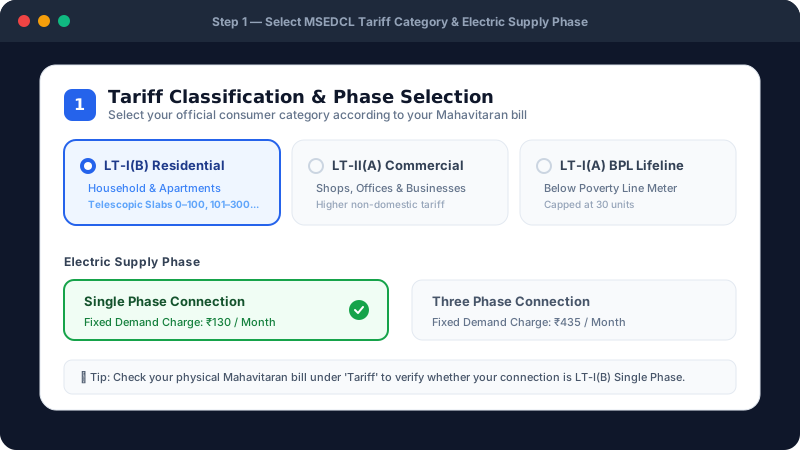
- Step 1: Select Tariff and Supply Phase: Choose LT-I(B) Residential and select either Single Phase (₹130/month) or Three Phase (₹435/month).
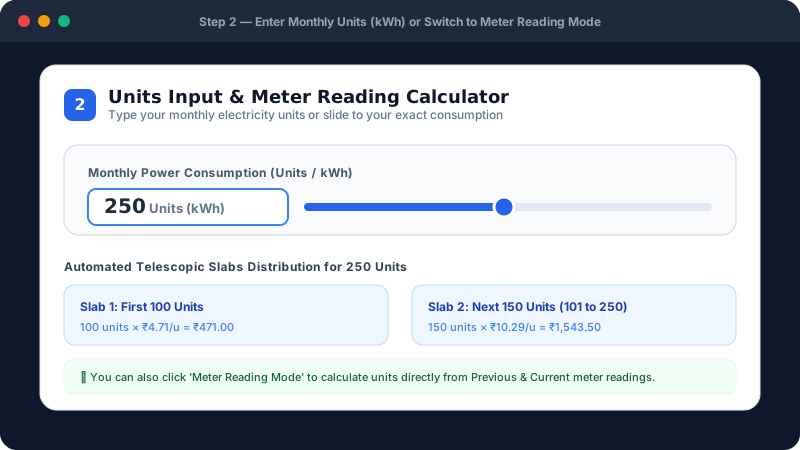
- Step 2: Enter Monthly Units or Meter Readings: Enter your monthly consumption in kilowatt-hours, or toggle Meter Reading Mode to input previous and current meter readings.
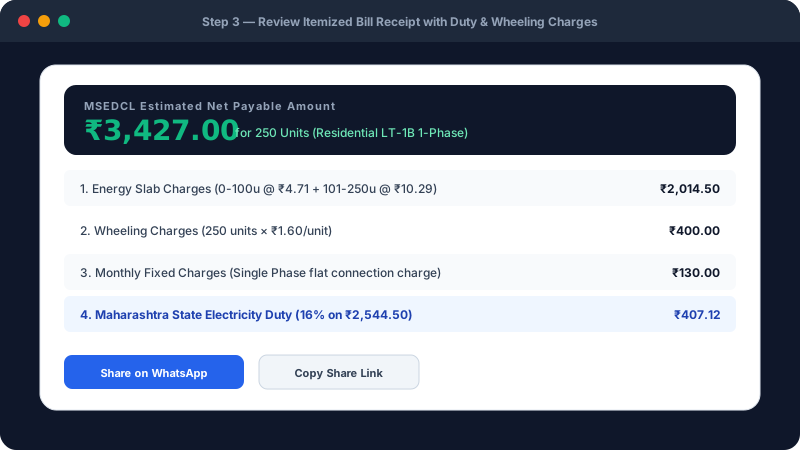
- Step 3: Review Itemized Bill Receipt: Inspect your progressive slab breakdown, wheeling fees, fixed charges, 16% electricity duty, and total net payable bill.
Commercial LT-II(A) tariff overview
For retail stores, commercial offices, salons, consulting clinics, and coaching institutes across Maharashtra, power is billed under LT-II(A) Commercial:
- Energy Charge (0 to 20 kW load): ₹8.51 per unit
- Wheeling Charge: ₹1.60 per unit
- Combined Variable Rate: ₹10.11 per unit
- Fixed Monthly Charge: ₹540.00 per month
- Electricity Duty: 16.00% on composite subtotal
For a small office consuming 400 units on an LT-II(A) commercial connection:
- Base Energy: 400 × ₹8.51 = ₹3,404.00
- Wheeling: 400 × ₹1.60 = ₹640.00
- Fixed Charge: ₹540.00
- Composite Subtotal: ₹4,584.00
- 16% Electricity Duty: ₹733.44
- Total Commercial Bill: ₹5,317.44
Appliance wattage breakdown: managing household power draw in Maharashtra
Because MSEDCL rates increase steeply above 100 units and 300 units, understanding which domestic appliances drive you into higher slabs is crucial for budget control. You can calculate individual device draw using the Electricity Unit (kWh) Calculator.
| Household appliance | Typical power rating | Daily running time | Monthly consumption (kWh) | Monthly cost impact (Slab 2 @ ₹12.40) |
|---|---|---|---|---|
| Inverter AC (1.5 Ton, 5-Star) | 1,000W - 1,200W | 7 hours / night | 110 - 130 units | ₹1,364.00 - ₹1,612.00 |
| Storage Water Heater (Geyser) | 2,000W | 1.5 hours / day | 90 units | ₹1,116.00 |
| Frost-Free Refrigerator (260L) | 180W | 24 hours (cyclic) | 40 units | ₹496.00 |
| Conventional Ceiling Fans (3 units) | 75W each (225W total) | 14 hours / day | 94.5 units | ₹1,171.80 |
| BLDC 5-Star Ceiling Fans (3 units) | 28W each (84W total) | 14 hours / day | 35.3 units | ₹437.72 (Saves ₹734/mo) |
| Water Lifting Pump (1 HP) | 750W | 1 hour / day | 22.5 units | ₹279.00 |
| Microwave Oven | 1,200W | 20 minutes / day | 12 units | ₹148.80 |
During hot summer months in Vidarbha, Marathwada, and coastal Konkan, running air conditioning can quickly push a home past 300 units. You can calculate specific cooling expenses with our AC Electricity Cost Calculator.
Four practical strategies to lower your MSEDCL electricity bill
To control power costs under Maharashtra's progressive tariff structure, focus on these four actionable steps:
- Maintain monthly consumption below the 300-unit threshold: The jump from Slab 2 (₹12.40 combined) to Slab 3 (₹16.64 combined) represents a 34% increase in per-unit variable costs. Setting inverter air conditioners to 25°C or 26°C instead of 18°C prevents the compressor from running continuously, often saving 40 to 60 units each month and keeping your home within Slab 2.
- Upgrade to 5-Star BLDC ceiling fans: In Maharashtra homes where multiple ceiling fans run throughout the day and night, replacing three traditional 75W induction fans with 28W brushless DC (BLDC) models reduces monthly consumption by nearly 60 units. At Slab 2 rates, that translates into savings of over ₹8,800.00 annually.
- Review your electric supply phase: If your home has a Three Phase meter (₹435.00/month) but your connected appliances do not include centralized air conditioning or commercial equipment, contact MSEDCL to downgrade to Single Phase (₹130.00/month). This single change saves ₹305.00 every month in flat fixed charges, plus ₹48.80 in duty savings, totaling ₹4,245.60 per year.
- Install grid-tied rooftop solar with net metering: Maharashtra has favorable net metering regulations under MERC. Installing a 2 kW or 3 kW rooftop solar system under the PM Surya Ghar subsidy program generates clean electricity that offsets your highest tariff slabs first. You can project your payback period and capital savings with our Solar Rooftop Savings Estimator.
Frequently asked questions about MSEDCL billing
Why does MSEDCL charge wheeling charges separately from energy charges?
Under MERC tariff regulations, wheeling charges represent the cost of operating the distribution network (cables, transformers, substations), while energy charges reflect the cost of buying electricity from power stations. Dividing these costs creates transparency and complies with the national Electricity Act open-access framework.
Why is electricity duty in Maharashtra higher than in other states?
The Government of Maharashtra levies a 16.00% duty on residential and commercial power under the Maharashtra Electricity Duty Act, 2016. Unlike states that levy duty only on base energy units (such as Karnataka at 9% or Tamil Nadu at 0% for domestic), Maharashtra applies the 16% rate to the composite sum of energy charges, wheeling fees, and fixed charges.
How do I check if my meter reading is accurate?
Locate your static electronic meter outside your home and press the push button until the screen displays cumulative kilowatt-hours (kWh). Compare this number with the current reading printed on your latest MSEDCL bill. The bill reading should match or be slightly lower than your current physical meter display.
Can residential consumers opt out of telescopic slabs in Maharashtra?
No. MERC mandates telescopic progressive slabs for all domestic LT-I(B) connections to promote energy efficiency and support subsidized lifeline consumption. Residential consumers cannot choose flat-rate commercial tariffs.
Where can I compare MSEDCL rates with other state DISCOMs?
You can compare Maharashtra tariffs with Bangalore's flat rate system using the BESCOM Bill Calculator, review Tamil Nadu's 60-day cycle using the TNEB Bill Calculator, or explore Kerala's bimonthly structure with the KSEB Bill Calculator. For all state rules and DISCOM profiles, visit the All India DISCOM Directory.
Found this helpful?
Share this guide with neighbors and family to help them cut electricity waste.
Mehedi
Chief Editor & Lead Systems AdminSenior energy analyst leading the editorial team across all-India state electricity regulatory commission (SERC) tariff orders, subsidy updates, and billing algorithm audits.