
How to Calculate KSEB Electricity Bill in Kerala: Slabs, Fixed Charges, and the 250-Unit Cliff
A practical engineering guide to calculating your Kerala State Electricity Board (KSEB) domestic power bill, understanding telescopic slabs, fixed charges, and avoiding the 250-unit non-telescopic tariff jump.
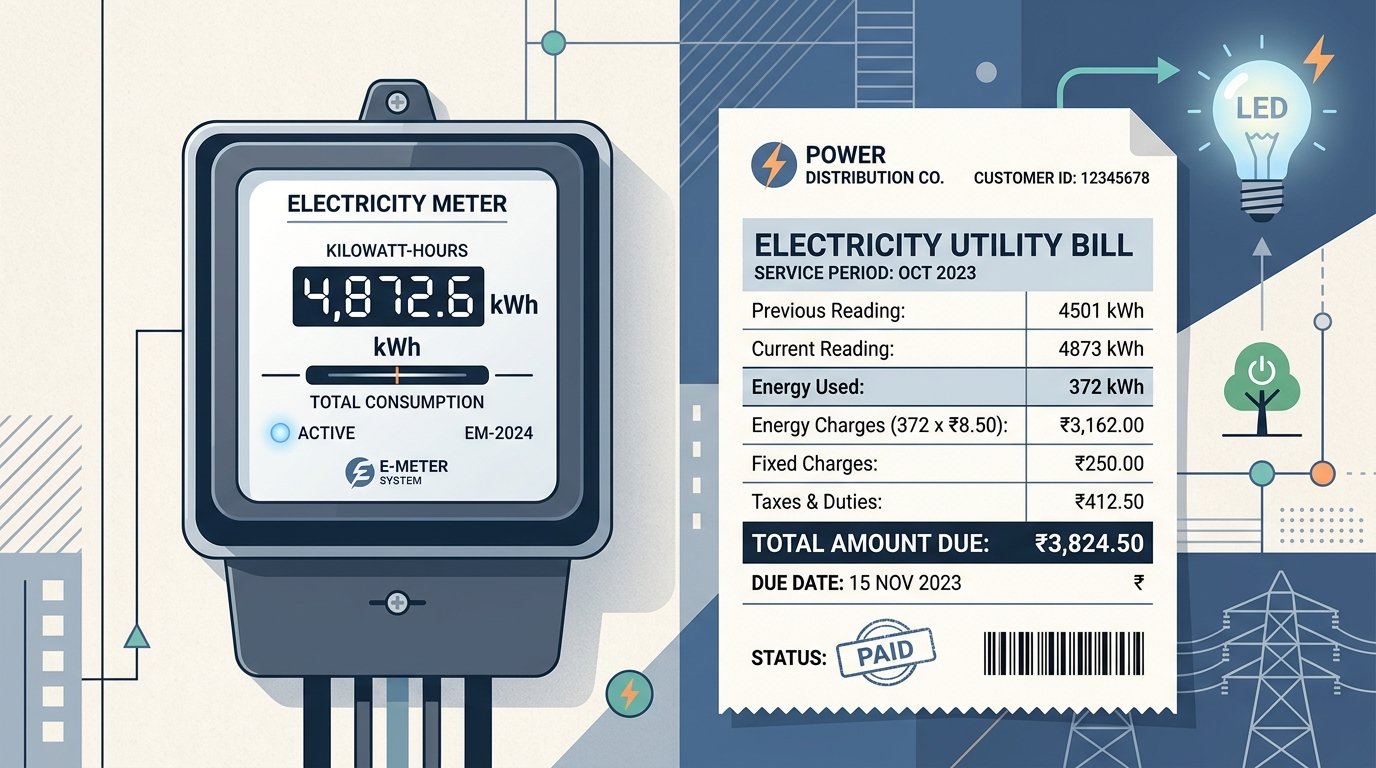
Table of Contents
- 1. Understanding the structure of a KSEB domestic bill
- 2. What is an energy charge?
- 3. Telescopic slabs for consumption up to 250 units
- 4. The 250-unit cliff: why 251 units costs so much more
- 5. Fixed charges on KSEB domestic connections
- 6. Concession tariff for BPL households
- 7. Step-by-step example: calculating a 220-unit domestic bill
- 8. How domestic appliances push your meter past 250 units
- 9. Practical strategies to stay below the 250-unit threshold
- 10. Frequently asked questions
Two neighbouring households in Ernakulam run similar domestic appliances during a typical summer month. The first household tracks their digital meter reading, records 250 units, and receives an energy charge of ₹1,432.50. The second household consumes just 251 units and faces an energy charge of ₹1,694.25 before taxes. A difference of a single kilowatt-hour increases their base energy charge by ₹261.75.
This sudden price jump occurs because the Kerala State Electricity Board (KSEB) switches the entire calculation method once consumption exceeds 250 units in a billing month. Understanding this billing structure helps households audit their monthly statements, budget appliance usage, and avoid unnecessary tariff penalties.
Understanding the structure of a KSEB domestic bill
Domestic consumers in Kerala fall under the Low Tension category LT-1A. Under Kerala State Electricity Regulatory Commission (KSERC) tariff orders, monthly domestic bills contain four primary components:
- Energy charges: The cost of actual electricity consumed in kilowatt-hours (kWh), billed under either telescopic or non-telescopic slab rates.
- Fixed charges: A recurring monthly demand fee based on your connection phase (single phase or three phase) and connected load.
- Electricity duty: A mandatory 10% statutory tax levied by the state government on base energy charges.
- Fuel price adjustment (FAC / FPPCA): A variable quarterly surcharge reflecting fuel procurement costs incurred by generation utilities.
Kerala operates on a monthly billing cycle for most urban domestic consumers, though bi-monthly spot billing applies in select distribution sections. The calculations below follow the standard 30-day monthly schedule.
What is an energy charge?
The energy charge represents the direct cost of the electrical power consumed by your household during the billing period. One unit of electricity equals one kilowatt-hour (1 kWh), which is equivalent to running a 1,000-watt appliance for exactly one hour.
In Kerala, energy charges do not use a single flat price for lower-income households. Instead, KSEB applies progressive tiers known as telescopic slabs for monthly consumption up to 250 units. When your usage remains within 250 units, every unit is billed within its assigned price bucket. Once you cross 250 units, that protection disappears.
Telescopic slabs for consumption up to 250 units
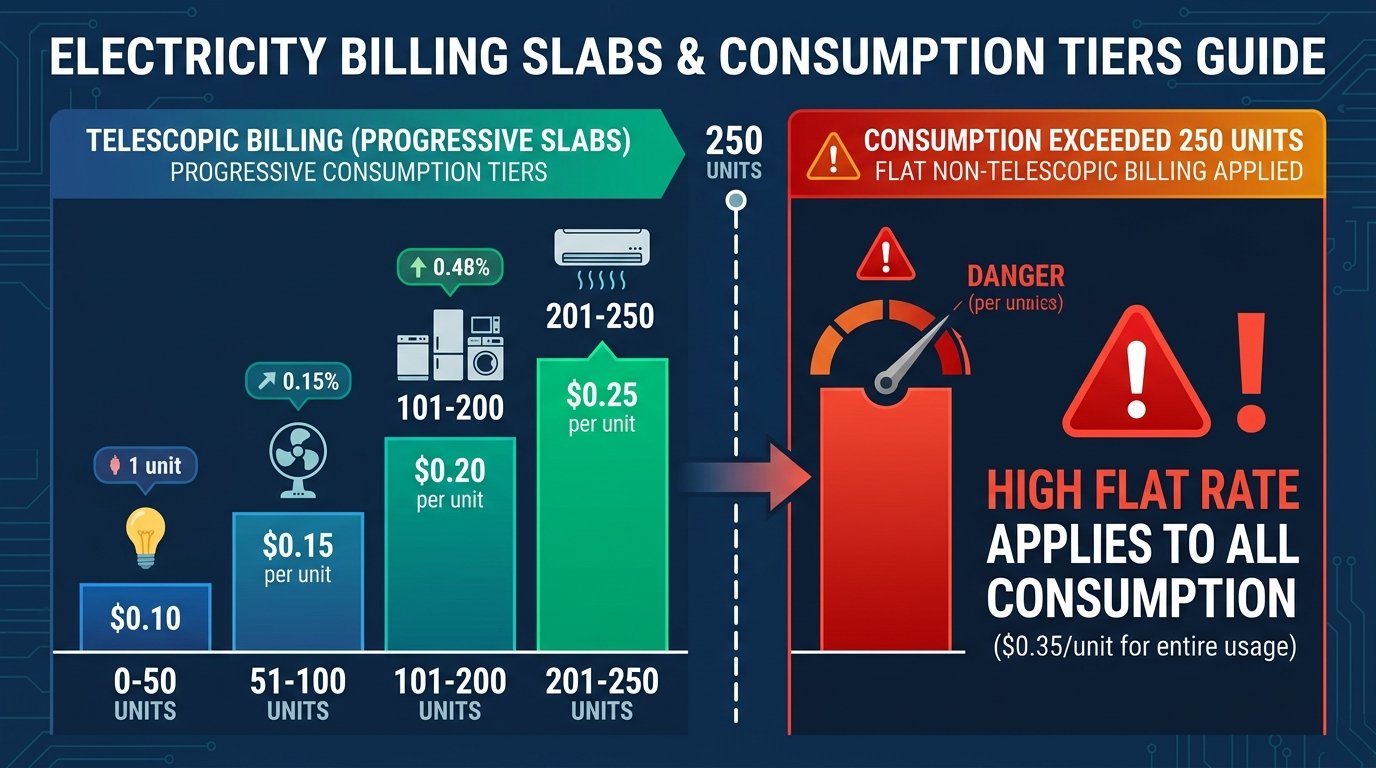
When monthly consumption is 250 units or fewer, KSEB breaks your usage into five distinct 50-unit blocks. Each block carries its own tariff rate:
| Monthly consumption slab | Energy rate per unit | Maximum slab cost | Cumulative energy charge |
|---|---|---|---|
| First 50 units (0 to 50) | ₹3.35 | ₹167.50 | ₹167.50 |
| Next 50 units (51 to 100) | ₹4.25 | ₹212.50 | ₹380.00 |
| Next 50 units (101 to 150) | ₹5.35 | ₹267.50 | ₹647.50 |
| Next 50 units (151 to 200) | ₹7.20 | ₹360.00 | ₹1,007.50 |
| Next 50 units (201 to 250) | ₹8.50 | ₹425.00 | ₹1,432.50 |
For example, if your household uses 180 units in a month, your energy charge is calculated across four separate slabs:
- 50 units at ₹3.35 = ₹167.50
- 50 units at ₹4.25 = ₹212.50
- 50 units at ₹5.35 = ₹267.50
- 30 units at ₹7.20 = ₹216.00
- Total base energy charge: ₹863.50
This stepped approach ensures that basic household needs like lighting and refrigeration stay economical. You can verify your exact figures using our KSEB Bill Calculator.
The 250-unit cliff: why 251 units costs so much more
The defining characteristic of the Kerala domestic electricity tariff is the abrupt transition from telescopic to non-telescopic billing once monthly consumption reaches 251 units.
When consumption passes 250 units, KSEB cancels all discounted introductory slabs. Instead of paying ₹3.35 for the first 50 units and ₹4.25 for the next 50 units, you are charged a uniform flat rate across your entire consumption, starting from unit number one:
| Monthly consumption range | Applicable tariff structure | Flat rate applied to all units |
|---|---|---|
| 1 to 250 units | Telescopic (stepped slabs) | Slabs from ₹3.35 to ₹8.50 |
| 251 to 300 units | Non-telescopic (flat) | ₹6.75 per unit on all units |
| 301 to 350 units | Non-telescopic (flat) | ₹7.65 per unit on all units |
| 351 to 400 units | Non-telescopic (flat) | ₹8.15 per unit on all units |
| 401 to 500 units | Non-telescopic (flat) | ₹8.70 per unit on all units |
| Exceeding 500 units | Non-telescopic (flat) | ₹9.20 per unit on all units |
Consider the real financial impact of crossing this boundary:
At 250 units on telescopic rates:
- Energy charge = ₹1,432.50
- 10% Kerala electricity duty = ₹143.25
- Subtotal = ₹1,575.75
At 251 units on non-telescopic rates:
- Energy charge = 251 units × ₹6.75 = ₹1,694.25
- 10% Kerala electricity duty = ₹169.43
- Subtotal = ₹1,863.68
Crossing from 250 to 251 units creates an immediate surcharge of ₹287.93 for a single unit of electricity. That single additional kilowatt-hour effectively costs nearly 34 times the standard slab rate.
Fixed charges on KSEB domestic connections
Fixed charges cover transmission maintenance, meter testing, and distribution infrastructure. Unlike energy charges, this fee does not drop to zero when the house is unoccupied.
For domestic LT-1A connections in Kerala, fixed charges depend on supply phase and connected load:
- Single phase domestic connection (connected load up to 2 kW): ₹40 per month.
- Single phase domestic connection (connected load above 2 kW): ₹60 per month.
- Three phase domestic connection: ₹130 per month.
If your home has a three phase connection for heavy appliances like ducted air conditioners or water pumps, you pay ₹130 each month in fixed charges alone, regardless of consumption.
Concession tariff for BPL households
KSEB maintains a lifeline tariff for families classified under Below Poverty Line (BPL) guidelines. To qualify, the consumer must satisfy two strict criteria:
- Connected load must not exceed 1,000 watts (1 kW).
- Monthly consumption must remain at or below 40 units.
Eligible BPL consumers receive power at a subsidized flat rate of ₹1.50 per unit with zero fixed charges. However, if a BPL consumer uses 41 units in a month, the lifeline concession is automatically revoked for that billing cycle, and normal LT-1A domestic slab rates apply from unit one.
Step-by-step example: calculating a 220-unit domestic bill
Here is a full breakdown for a typical Kerala household on a single phase connection consuming 220 units:
- Calculate slab 1 (0 to 50 units): 50 × ₹3.35 = ₹167.50
- Calculate slab 2 (51 to 100 units): 50 × ₹4.25 = ₹212.50
- Calculate slab 3 (101 to 150 units): 50 × ₹5.35 = ₹267.50
- Calculate slab 4 (151 to 200 units): 50 × ₹7.20 = ₹360.00
- Calculate slab 5 (201 to 220 units): 20 × ₹8.50 = ₹170.00
- Total base energy charge: ₹1,177.50
- Add single phase fixed charge: ₹40.00
- Add 10% Kerala electricity duty: 10% of ₹1,177.50 = ₹117.75
- Net payable amount before fuel surcharge adjustments: ₹1,335.25
To see how this bill compares with neighboring states like Tamil Nadu or Karnataka, test the same 220 units on our State Electricity Tariff Comparison Calculator.
How domestic appliances push your meter past 250 units
Most households that exceed 250 units do not realize which appliance crossed the threshold. Tracking wattage helps maintain control over your monthly consumption:
Air conditioners
A modern 1.5-ton 3-star inverter split air conditioner consumes approximately 1.2 to 1.5 units per hour during peak room pull-down, settling around 0.8 units per hour once room temperature stabilizes. Running one AC for 6 hours each night adds 140 to 180 units to your monthly bill. If your base consumption from lights, fans, and a refrigerator is 100 units, the AC instantly pushes you across the 250-unit cliff into non-telescopic pricing. You can calculate specific cooling expenses with our AC Electricity Cost Calculator.
Storage water heaters (geysers)
A 2,000-watt storage geyser consumes 2 units for every hour of heating element operation. A family that leaves a geyser turned on for 45 minutes each morning consumes roughly 45 units per month on water heating alone.
Ceiling fans
Traditional induction motor ceiling fans consume 70 to 80 watts. Running four fans for 14 hours daily consumes approximately 100 units per month. Switching to brushless DC (BLDC) motor fans rated at 28 to 32 watts cuts fan energy consumption to under 40 units per month. That 60-unit saving is frequently enough to keep a home below the 250-unit threshold. You can estimate individual device consumption using our Electricity Unit (kWh) Calculator.
Practical strategies to stay below the 250-unit threshold
- Monitor your meter on day 20 of each billing cycle. If your consumption is approaching 180 units with 10 days remaining, reduce secondary appliance run-times immediately.
- Set inverter air conditioners to 25°C or 26°C with ceiling fan circulation rather than 20°C. Each degree increase cuts compressor power consumption by roughly 6%.
- Install an automated timer or turn off storage water heaters within 15 minutes of turning them on.
- If your monthly consumption consistently sits between 350 and 500 units, consider installing grid-tied rooftop solar. Under the PM Surya Ghar Muft Bijli Yojana, a 2 kW or 3 kW solar array generates 240 to 360 units monthly, bringing your grid draw back into the lowest telescopic tiers. You can review investment return timelines using our Solar Rooftop Savings Estimator.
Frequently asked questions
How do I calculate my KSEB domestic bill from meter readings?
Subtract your previous meter reading from your current reading to find consumed units. If units are 250 or fewer, apply the five telescopic slabs, add the fixed charge based on your phase, and add 10% electricity duty. If units exceed 250, multiply total units by the applicable non-telescopic flat rate before adding fixed charges and duty.
What is the difference between single phase and three phase fixed charges in Kerala?
Single phase domestic consumers pay ₹40 monthly for loads up to 2 kW (or ₹60 for loads above 2 kW). Three phase domestic consumers pay a flat ₹130 monthly regardless of load.
Why did my KSEB bill increase significantly for using just a few more units?
Once monthly consumption passes 250 units, KSEB removes the lower slab rates for the first 200 units and bills your entire consumption at a single flat rate of ₹6.75 per unit or higher.
Does KSEB offer free electricity units like other states?
Unlike Delhi or Punjab, Kerala does not offer universal free power quotas for domestic users. Subsidized rates apply only to verified BPL households consuming 40 units or fewer per month.
How does Kerala electricity tariff compare with Tamil Nadu TNEB?
Tamil Nadu operates on a bi-monthly billing cycle with a 100-unit free electricity subsidy for all domestic consumers, while Kerala bills monthly with a strict 250-unit telescopic cliff. You can compare state structures directly on our All State Electricity Boards Directory.
Found this helpful?
Share this guide with neighbors and family to help them cut electricity waste.

Er. Rajesh Sharma
Senior Tariff & Renewable Energy SpecialistPower systems engineer with 12+ years of experience researching electricity distribution companies (DISCOMs), telescopic slab calculations, solar net metering, and residential appliance energy efficiency.