Home Calculator States & DISCOMs Blog
⚡ ALL INDIA POWER TARIFF ENGINE 2026 • 28 STATES & UTs

All-India Electricity Bill Calculator 2026 – State-Wise Power Tariff Estimator

Calculate monthly power consumption, official telescopic tariff slabs, fixed demand charges, and government subsidies across all Indian DISCOMs directly on this page.

SERC FY 2025–26 Tariffs 100% Telescopic Multi-Tier Engine 🛡️ BEE Certified Auditor Verified
Interactive Engine

Configure Your Power Meter & Tariff

kWh
Karnataka Gruha Jyothi Scheme Free power up to entitlement (max 200 units)
Delhi DERC Zero Bill Subsidy 100% subsidy on ≤200 units, 50% for 201-400 units

Total Net Payable Bill

Effective Rate / Unit
Energy Charges (Telescopic Slabs)
Fixed Demand Charges
Fuel Adjustment Surcharge (FPPPA / FAC)
Electricity Duty & Taxes
View Dedicated DISCOM Page →
National Benchmark

📊 All-India 10-State Electricity Tariff Benchmark 2026 (250 kWh Comparison)

Compare how power bills for 250 units (2 kW Domestic Load) rank across Indian states with telescopic slabs and active government subsidies.

Rank State & DISCOM Avg Rate (₹/unit) Monthly Bill (₹) Subsidy / Scheme Status Action
#1 PSPCL Punjab • Bi-Monthly (60 Days) ₹0.00 ₹0 (Free) 100% Subsidy (Free) Calculate
#2 BSES Delhi Delhi • Monthly (30 Days) ₹2.87 ₹717 50% Subsidy up to ₹800/mo (201-400 units) Calculate
#3 TNEB / TANGEDCO Tamil Nadu • Bi-Monthly (60 Days) ₹3.31 ₹828 200 units free per bi-monthly cycle (100u/mo free) Calculate
#4 TGSPDCL / TSSPDCL Telangana • Monthly (30 Days) ₹6.16 ₹1,540 Group C (Non-BPL) high telescopic rates from unit 1 Calculate
#5 APDCL Assam • Monthly (30 Days) ₹6.18 ₹1,545 AERC telescopic slabs + FPPPA fuel surcharge + fixed demand charge Calculate
#6 UPPCL Uttar Pradesh • Monthly (30 Days) ₹6.87 ₹1,716 UPERC urban domestic: ₹5.50 (0-150u), ₹6.00 (151-300u), ₹6.50 (301-500u) + ₹110/kW fixed Calculate
#7 KSEB Kerala • Bi-Monthly (60 Days) ₹7.07 ₹1,767 KSEB bi-monthly telescopic domestic slabs (₹3.50 to ₹9.30) + fixed charges Calculate
#8 WBSEDCL West Bengal • Quarterly (90 Days) ₹7.86 ₹1,965 Quarterly 90-day telescopic energy + fixed + MVCA + 5% state duty Calculate
#9 BESCOM Karnataka • Monthly (30 Days) ₹8.26 ₹2,066 Single flat energy rate ₹5.80 + ₹150/kW fixed + 9% duty (No Gruha Jyothi if >200u) Calculate
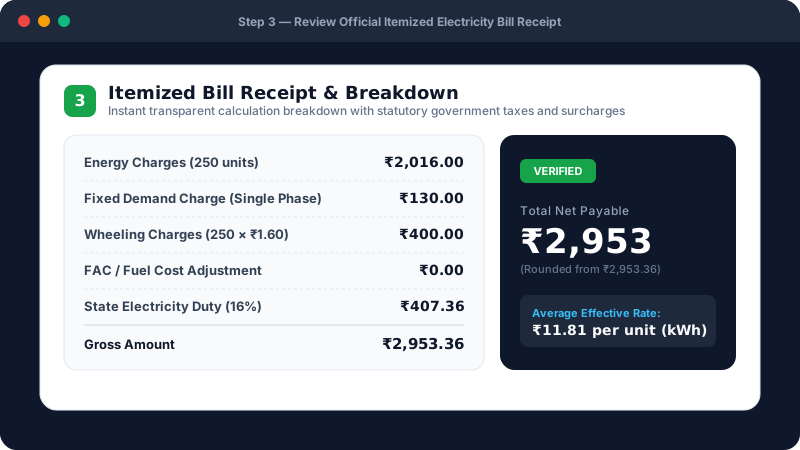
#10 MSEDCL / Mahavitaran Maharashtra • Monthly (30 Days) ₹11.81 ₹2,953 Highest tariff: base energy + ₹1.60/u wheeling charge + 16% composite duty Calculate
Interactive Visual Walkthrough

How to Use the All India Electricity Bill Calculator
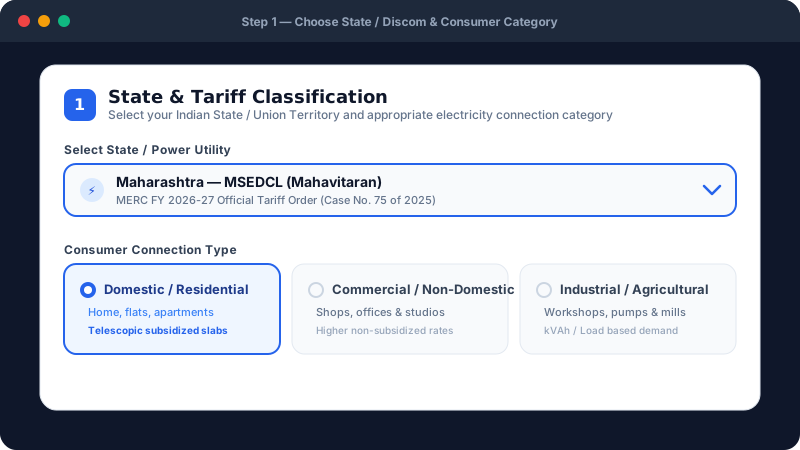
Universal Electricity Bill Calculator Step 1 state and tariff category selection screenshot
🔍 Click to Expand
Step 1
Step 1: Select State / Discom & Category Choose your Indian State or Union Territory and select Domestic, Commercial, or Industrial connection type.
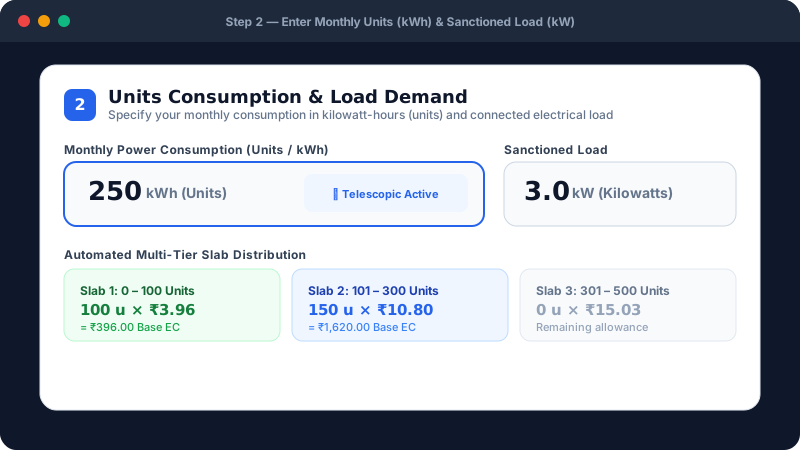
Universal Electricity Bill Calculator Step 2 units and load demand input screenshot
🔍 Click to Expand
Step 2
Step 2: Enter Monthly Units & Sanctioned Load Input monthly electricity consumption in kWh (units) and your meter sanctioned load in kW with real-time slab preview.
Universal Electricity Bill Calculator Step 3 itemized bill receipt with duty screenshot
🔍 Click to Expand
Step 3
Step 3: Review Itemized Bill Receipt View complete transparent bill breakdown including base energy charges, fixed demand, wheeling/fuel charges, and state electricity duty.

🖼️

🛡️ Fact-Checked & Verified by Certified Energy Auditor

Verified Against State Regulatory Commission (SERC) Tariff Orders

Calculating an electricity bill in India isn't just basic arithmetic—it follows legally binding tariff schedules issued by State Electricity Regulatory Commissions (SERCs) under Section 62 and Section 86 of The Electricity Act, 2003. Our estimation engine is reviewed by Er. S. Mukherjee, Certified Energy Auditor (BEE Reg #CEA-8492) accredited by the Bureau of Energy Efficiency (BEE), Ministry of Power, Govt of India.

Lead Auditor Er. S. Mukherjee BEE CEA Reg #8492
Statutory Authority SERCs & CERC Sec 62 Electricity Act
Tariff Schedules FY 2025–26 Gazettes Updated Sep 2026

Our Audit Standards

  • Direct tariff order verification from official state electricity gazettes.
  • Accurate telescopic slab division matching DISCOM billing systems.
  • Direct accounting for state lifeline quotas and DBT subsidy deductions.
Calculation Engine

Universal Electricity Bill Calculation Formula in India

Learn how an Indian power bill is calculated step-by-step from raw kilowatt-hour (kWh) meter readings down to duties and subsidies.

// Official Regulatory Tariff Equation
Total Bill (₹) = Energy Charges [Slabs] + Fixed Demand Charges + Fuel Adjustment (FPPPA) + Electricity Duty - Subsidies

Step-by-Step Math (Example: 250 kWh, 2 kW Domestic Load):

1. Slab 1 (0 to 100 units @ ₹4.50/u): ₹450.00
2. Slab 2 (101 to 200 units @ ₹6.50/u): ₹650.00
3. Slab 3 (201 to 250 units @ ₹8.00/u): ₹400.00
Total Energy Charges: ₹1,500.00
4. Fixed Demand Charge (2 kW @ ₹80/kW/month): ₹160.00
5. Fuel Surcharge FPPPA (250 u @ ₹0.45/u): ₹112.50
6. State Electricity Duty (6% on Energy): ₹90.00
Gross Bill Amount: ₹1,862.50
7. State Subsidy / Lifeline Discount: - ₹200.00
Net Payable Bill: ₹1,662.50

Why Telescopic Slabs Save You Money

Unlike flat-rate billing where every unit is billed at a high rate once you cross a threshold, India's telescopic slab system bills your initial units at low, subsidized rates.

Even if your monthly consumption reaches 350 or 400 units, your first 100 units are always charged at the Tier 1 base rate. This progressive structure safeguards domestic households while ensuring heavy consumers pay their fair share of power generation costs.

💡 What Causes Sudden Bill Spikes? Crossing into a higher tier doesn't just raise your per-unit cost—in states like Maharashtra and Delhi, it also escalates your monthly Fixed Demand Charges to a higher rate tier.
Auditor Guidelines

5 Practical Ways to Lower Your Electricity Bill in India

Actionable energy efficiency strategies verified by Certified Energy Auditors to keep your consumption inside lower telescopic slabs.

1

The 24°C AC Thermostat Rule

Research by the Bureau of Energy Efficiency (BEE) confirms that every 1°C increase in AC temperature setting saves 6% electricity. Setting your air conditioner to 24°C instead of 18°C cuts cooling costs by up to 24% every month.

2

Switch to 5-Star BLDC Ceiling Fans

Conventional induction ceiling fans consume 75W–80W. Upgrading to 5-Star BLDC (Brushless DC) fans that use only 28W–32W saves around ₹1,500 per fan annually with 12 hours of daily usage.

3

Manage Peak Demand (MDI)

Avoid running multiple heavy-draw appliances at the same time (such as water geysers, induction cooktops, and air conditioners). With smart meters rolling out under the RDSS scheme, exceeding your Sanctioned Load triggers a 200% demand penalty.

4

Eliminate Phantom Standby Power

Televisions, set-top boxes, Wi-Fi routers, and microwave clocks draw standby power 24 hours a day. Turning off switches at the wall socket when appliances aren't in use saves 5%–10% on your monthly bill.

5

Install PM Surya Ghar Rooftop Solar

Under the Central Government's PM Surya Ghar Muft Bijli Yojana, residential homeowners receive direct capital subsidies of up to ₹78,000 for 3 kW rooftop solar systems, reducing grid power bills down to zero.

Specialized Power Tools

Use our dedicated calculators for tenant sub-meter splitting, AC power consumption, and solar payback.

Solar Savings Calculator →
Consumer FAQs

Frequently Asked Questions on Electricity Billing in India

Authoritative answers to common questions about tariffs, smart meter readings, fuel surcharges, and subsidies.

In India, electricity bills are calculated using a telescopic slab structure established by State Electricity Regulatory Commissions (SERCs) under Section 62 of The Electricity Act, 2003. Total Bill = Energy Charges (units divided into progressive tiers at increasing rates) + Fixed Demand Charges (per kW connected load) + Fuel Surcharge Adjustment (FPPPA / FAC) + State Electricity Duty & Taxes - Government Subsidies.
A telescopic slab system divides your total consumed units into progressive blocks. For example, if you use 250 units: the first 100 units are charged at the lowest base tier (e.g. ₹4.50/unit), the next 100 units (101 to 200) at an intermediate tier (e.g. ₹6.50/unit), and the remaining 50 units (201 to 250) at the top tier (e.g. ₹8.00/unit). This protects essential domestic consumption while discouraging energy wastage.
Fixed Demand Charges cover the capital cost incurred by power distribution companies (DISCOMs) to maintain transmission lines, local transformers, substations, and smart metering networks to keep power available 24/7. They are billed per kilowatt (kW) of sanctioned connected load (e.g. ₹75 to ₹150 per kW per month) regardless of whether you consume 0 units or 500 units.
FPPPA stands for Fuel and Power Purchase Price Adjustment (also called FAC - Fuel Adjustment Charge). Because coal, natural gas, and market power purchase prices fluctuate regularly, state regulatory commissions permit DISCOMs to add or deduct a minor per-unit charge (typically between ₹0.20 and ₹0.85 per kWh) on a monthly or quarterly basis.
Key state subsidies in 2026 include: 1) Karnataka Gruha Jyothi (free power up to 200 units based on historical consumption), 2) Delhi DERC scheme (100% subsidy for ≤200 units, 50% subsidy for 201–400 units), 3) Punjab PSPCL Lifeline (300 free units per month for domestic consumers), 4) Tamil Nadu TANGEDCO (first 100 units free for all domestic consumers), and 5) West Bengal Hasir Alo (free power for lifeline consumers using up to 75 units quarterly).
Crossing key consumption thresholds creates a steep bill increase due to three compounded factors: 1) Higher progressive slab rates apply to all additional units, 2) In states like Maharashtra and Delhi, crossing consumption limits moves your account to a higher Fixed Demand Charge bracket, and 3) In states with cliff subsidies (such as Delhi), crossing 200 units revokes the 100% discount, requiring payment for the full bill.
Electricity Duty (ED) is a statutory tax levied directly by State Governments (separate from DISCOM energy charges) under state electricity duty legislation. It varies from 0% to 16% across different Indian states or is charged as a flat rate per unit (e.g., 10 to 25 paise per kWh).
Commercial consumers pay significantly higher fixed demand charges (typically ₹250 to ₹400/kW/month compared to ₹60 to ₹120/kW for domestic) and higher energy slab rates (often ₹8 to ₹13/unit) due to cross-subsidization policies under the National Tariff Policy. Furthermore, with smart meters, exceeding your sanctioned load incurs an automatic 200% overload demand penalty.